

To build a custom contact form on Wix, open the Wix Editor, click the '+' icon, select 'Contact & Forms,' pick a template, then add your fields, enable CAPTCHA, and configure email notifications, or connect Gmail to Wix so all form replies arrive in your Gmail inbox alongside your other messages. The whole process takes under 15 minutes and requires zero coding.
A Wix contact form gives visitors a structured, professional way to reach you without exposing your email address to spam bots. This guide covers the full Wix forms tutorial from start to finish: choosing a template, customizing field types like dropdowns and file uploads, setting up submission handling, preventing spam, exporting your submission data, and designing a form that actually gets filled out.
Step-by-Step Guide: How to Build a Custom Contact Form on Wix
Building a custom contact form on Wix is straightforward using the built-in Wix Forms tool. The steps below cover the full process: from inserting the form onto your page to configuring notifications and going live.
Step 1: Click '+' and Select 'Contact & Forms'

Open your Wix Editor and click the '+' icon on the left-hand panel to open the Add Elements menu. Select 'Contact & Forms' from the list to access the Wix form builder. This section contains all available form types and templates ready to drop onto your page.
Step 2: Select Your Preferred Form Template

Wix offers form templates for different purposes: contact forms, feedback forms, quote request forms, subscription sign-ups, and order forms. Choose a template that fits your goal, or select 'Create New Form' to start from a blank canvas. You can also choose 'Add Existing Form' if you've already created one elsewhere on your site.
For a basic contact form, the default "Contact Us" template works well. It comes pre-loaded with name, email, phone, and message fields that you can modify in the next step.
Step 3: Add and Customise Your Form Fields

Click on the form to open the Form Settings panel, then add or remove fields to match the information you need to collect. The Wix form builder supports these field types:
- Short text: for names, subjects, or short answers
- Long text: for messages or detailed enquiries
- Email: with built-in format validation that rejects invalid addresses
- Phone number: includes country code selection and number formatting
- Dropdown menus: great for categorising enquiry types (e.g., "Sales," "Support," "Billing")
- Checkboxes: for multi-choice options like selecting services or interests
- Radio buttons: for single-choice questions where only one answer applies
- File upload: let visitors attach documents, images, or PDFs (up to 25 MB per file)
- Date picker: ideal for booking or appointment request forms
- Time picker: pair with date picker for scheduling-specific forms
- Rating: useful for feedback and satisfaction survey forms
- Signature: collect e-signatures for agreements or consent forms
Keep your form concise. Ask only for what you genuinely need. Forms with 3-5 fields consistently get higher completion rates than those with 7 or more. You can always use conditional logic (covered below) to show additional fields only when they're relevant.
Step 4: Set Required Fields and Validation
For each field, decide whether it should be required or optional. Click a field, open its settings, and toggle the 'Required Field' switch. Mark essential fields like name and email as required, and leave others optional to reduce friction.
Wix automatically validates email and phone fields to check formatting, but you can add custom validation rules for text fields too. For example, set a minimum character count on a message field to prevent blank or single-word submissions.
Step 5: Enable CAPTCHA and Spam Protection
Spam submissions are a common problem with any public-facing form. To protect your Wix contact form from bots and automated spam, you have two layers of defence:
CAPTCHA verification:
- In the Form Settings panel, go to the Submit tab.
- Toggle on 'Add CAPTCHA' to add an invisible or checkbox CAPTCHA challenge.
- Invisible CAPTCHA runs in the background and only shows a challenge when it detects suspicious behaviour, so legitimate visitors won't be interrupted.
Built-in spam filtering: Wix includes automatic spam detection that works alongside CAPTCHA. It analyses submission patterns, IP addresses, and form completion speed to flag likely bot submissions. You can review flagged submissions in your Forms dashboard and mark false positives.
Honeypot fields (third-party forms): If you use a third-party form builder like Jotform or 123FormBuilder on your Wix site, look for a honeypot option. Honeypot fields are hidden form fields invisible to real visitors but filled in by bots. Any submission that includes data in the honeypot field gets automatically rejected. This method blocks spam without requiring visitors to solve a CAPTCHA challenge.
Step 6: Set Up Email Notifications and Submission Handling
Configuring how you receive and manage form submissions is critical. The Wix form builder gives you several options:
Email notifications:
- In the Form Settings panel, click the 'Notifications' tab.
- Under 'Email Notifications,' enter the email address where you want to receive form submissions. You can add multiple recipient addresses separated by commas.
- Customise the notification email subject line so you can instantly recognise incoming enquiries (e.g., "New Contact Form Submission - ").
- Enable an auto-reply email to send an automatic confirmation message to the person who submitted the form. This reassures them their message was received and sets expectations for your response time.
If you want form submissions to go to a different address than your main site email, check our guide on Wix email forwarding for setup instructions.
CRM and automation connections: Connect your form to your CRM system to automatically log contacts, create deals, and assign follow-up tasks. Wix's built-in Ascend CRM captures every submission by default, but you can also connect to third-party CRMs like HubSpot or Salesforce through the Wix App Market.
Automations: Set up Wix Automations to trigger actions when a form is submitted. Common automations include sending a follow-up email after 24 hours, adding the contact to a mailing list, notifying a team member via Slack, or creating a task in your project management tool.
Step 7: Configure a Thank-You Page or Message
After a visitor submits your form, you need to give them clear feedback that their message was sent. Wix lets you choose between two options:
- On-page thank-you message: a short confirmation message that appears in place of the form after submission. Simple and effective for most sites.
- Redirect to a thank-you page: send visitors to a dedicated page. This is better for tracking conversions in Google Analytics or ad platforms, as you can fire a page-view event on that URL.
To set this up, go to the 'Submit' tab in Form Settings and select your preferred post-submission action. If you redirect to a page, create a simple, friendly thank-you page that confirms receipt and sets expectations for your response time. For tips on building effective standalone pages, see our guide on how to make a landing page on Wix.
Step 8: Add Conditional Logic (Optional)
For more advanced forms, Wix supports conditional logic: the ability to show or hide fields based on how a visitor answers previous questions. For example:
- Show a "Project Budget" field only if the visitor selects "New Project" from a dropdown.
- Hide a phone number field unless the visitor checks "Yes, please call me."
- Display a "Company Name" field only when the visitor selects "Business" as their enquiry type.
- Show a file upload field only when the visitor requests a quote and needs to share specifications.
To add conditional logic, click on a field and look for the 'Conditions' option in the field settings. This feature is available on Wix's paid plans and makes your custom contact form on Wix feel tailored to each visitor's needs. For a full breakdown of this and other advanced features, see our guide on how to use Wix Forms.
Step 9: Style Your Form and Publish
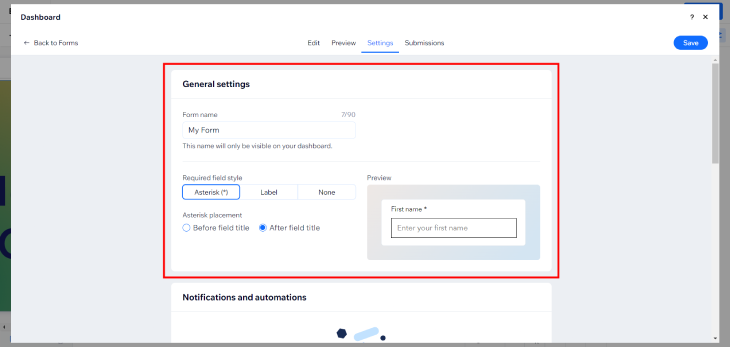
Before publishing, customise the visual appearance of your form to match your site's branding. Click the form and select 'Design' to adjust:
- Background colour and border style of form fields
- Button colour, text, and hover effects
- Font family and size for labels and placeholders
- Spacing and layout to ensure the form is mobile-friendly
- Corner radius for rounded or sharp field edges
Once you're happy with the design, click 'Save' in the top right corner of the Wix Editor, then hit 'Publish' to make your form live on your website.
How to Export Wix Form Submissions (CSV/Spreadsheet)
One question that comes up constantly is how to get your form submission data out of Wix and into a spreadsheet. Whether you need to analyse enquiry trends, import contacts into another tool, or share records with a colleague, Wix lets you export submissions directly to a CSV file.
Accessing the Submissions Dashboard
Go to your Wix dashboard and click Forms in the left-hand menu. Select the form you want to export from, then click the Submissions tab. You'll see a table of every submission with columns for each field, the submission date, and the submission status (new, viewed, archived, or spam).
How to Export All Submissions to CSV
- In the Submissions tab, click the Export button (top right of the submissions table). On some Wix accounts, this appears as a download icon.
- Wix generates a CSV file containing every submission for that form, including all field values, submission timestamps, and contact IDs.
- The file downloads automatically to your computer. Open it in Excel, Google Sheets, or any spreadsheet tool.
Each row in the CSV represents one submission. Column headers match your form field labels, so if you named a field "Project Budget," that's the column name in the export.
Filtering Before You Export
If you only need a subset of submissions, filter first before exporting. Use the date range filter to pull submissions from a specific period (e.g., last month's enquiries). You can also filter by submission status: export only "New" submissions to see unread enquiries, or filter to "Archived" to export closed records separately.
Wix does not currently let you filter by a specific field value (e.g., "export only submissions where Enquiry Type = Sales") before exporting. If you need that level of filtering, export the full CSV and apply filters inside your spreadsheet tool after the fact.
Connecting to Google Sheets Automatically
For ongoing data collection without manual exports, connect your Wix form to Google Sheets using a Wix Automation. Set the trigger to "Form submitted" and the action to "Update a Google Sheet row." Every new submission then writes a new row to your sheet in real time. This is far more practical than regular manual exports if you receive more than a handful of submissions per week.
Using Your Exported Data
Once you have the CSV, the most common use cases are:
- Importing contacts into an email marketing platform (Mailchimp, ActiveCampaign, etc.)
- Building a lead tracker in Excel or Google Sheets with custom columns for follow-up status
- Sending the data to a client or team member who doesn't have Wix dashboard access
- Running a mail merge to send personalised follow-up emails from your own inbox
- Analysing submission volume over time to spot seasonal patterns in enquiries
How to Embed a Wix Contact Form on Another Website
Most guides assume you only want your Wix form on your Wix site. But there's a lesser-known use case: embedding your Wix contact form on a completely different website, whether that's a WordPress blog, a Squarespace page, or any other platform that accepts HTML.
Why You Might Want to Do This
If you manage multiple websites but want all enquiries centralised in one Wix submissions dashboard, embedding the same form across sites keeps your data in one place. It also means you only need to update the form once in Wix and the change reflects everywhere it's embedded.
How to Get the Embed Code from Wix
- In your Wix Editor, click on the contact form to select it.
- Click the three-dot menu (or right-click the form) and look for 'Get Embed Code' or 'Share' options. In some Wix versions, this is under the form's settings panel.
- Alternatively, in your Wix Forms dashboard (not the editor), open the form and look for a Share or Embed option in the top toolbar.
- Wix provides an iframe embed snippet. Copy this code.
Embedding the Form on Another Platform
Paste the iframe code into an HTML block on your external site. On WordPress, use a Custom HTML block in the Gutenberg editor. On Squarespace, use a Code block. On any platform that accepts raw HTML, the process is the same: find the HTML embed option, paste the code, and save.
The form will appear on the external page with the same fields and styling as on your Wix site. Submissions go directly to your Wix Forms dashboard, so you manage everything from one place regardless of which site the visitor used.
Limitations to Be Aware Of
- Styling constraints: The form inherits its visual design from Wix. You can style it in the Wix Editor, but you cannot apply the external site's CSS to the iframe content directly.
- CAPTCHA behaviour: Wix's invisible CAPTCHA should still function inside an iframe, but some browsers with strict third-party cookie settings may behave differently. Test the embedded form in your target browsers before relying on it.
- Wix account required: The form is still hosted by Wix. If your Wix subscription lapses, the embedded form stops working on external sites too.
- Mobile responsiveness: Set a fixed width on the iframe that works across screen sizes, or use CSS to make the iframe wrapper responsive (e.g., width: 100%; max-width: 600px).
This approach works best for small teams who want a single submission inbox without setting up a separate form tool for each website they manage.
Troubleshooting: Wix Contact Form Not Working
If your Wix contact form is live but not functioning correctly, these are the most common issues and their fixes.
Not Receiving Email Notifications
This is the most frequently reported Wix form problem. Check these in order:
- Check your spam folder. Wix notification emails are sometimes filtered as spam. Look for emails from [email protected] or your site's domain.
- Verify the notification email address. Go to Form Settings > Notifications and confirm the email address matches your inbox exactly. A single typo will silently redirect all submissions.
- Check your Wix Mailbox. Even if email delivery fails, Wix stores all submissions in your Forms dashboard (Site Dashboard > Forms > Submissions). Check there to confirm whether submissions are actually being received.
- Check your email provider's filters. If you use Google Workspace or Microsoft 365, your domain's email filters may be blocking Wix's sending domain. Ask your IT admin to whitelist mail.wix.com and the Wix sending IP ranges.
- Test with a different email address. Create a test submission and enter a Gmail or personal email as the recipient temporarily. If you receive it there but not your business email, the issue is with your business email's filters.
Form Not Submitting (Button Doesn't Work)
If clicking the submit button does nothing or shows an error, the form likely has a validation issue or a required field that isn't filled. Test the form yourself by submitting with intentionally blank fields to see which validation errors appear. If the button appears completely unresponsive even with all fields filled, try republishing the site. Sometimes the Wix editor caches a broken state that a fresh publish resolves.
Form Submissions Going to Spam
If visitors are submitting but you're seeing low-quality or bot submissions despite CAPTCHA being enabled, check that CAPTCHA is actually toggled on in the Submit tab of Form Settings (not just installed, but actively enabled). Also review your spam threshold settings in the Forms dashboard. Wix may have flagged legitimate submissions as spam if they came from a new or unusual IP address.
Form Not Showing on Mobile
If your form is visible on desktop but missing on mobile, check the mobile editor. The form element may have been hidden specifically for mobile. Open the Wix Editor, switch to mobile view, click the area where the form should appear, and check if the element has been set to "Hidden on Mobile." Toggle it back to visible and republish.
Conditional Logic Fields Not Showing or Hiding Correctly
If conditional logic isn't working as expected, verify that you're on a Wix paid plan (conditional logic is not available on the free plan). Also check that each condition references the correct field name and value exactly as it appears in the form settings. A mismatch in case or spelling prevents the logic from triggering.
How to Build a Multi-Step Contact Form on Wix
If your contact form needs more than 5-6 fields, a single long form can feel overwhelming and drive visitors away. Multi-step forms fix this by breaking the form into smaller, numbered sections that visitors complete one at a time.
To create a multi-step form on Wix:
- Open the Wix Forms app from your dashboard (not the editor). Go to Wix App Market and install it if you haven't already.
- Click 'Create New Form' and select 'Multi-Step Form' as the layout type.
- Add your first group of fields (e.g., name and email) to Step 1.
- Click 'Add Step' to create Step 2, then add the next set of fields (e.g., enquiry type, budget range).
- Repeat for additional steps. Most forms work best with 2-3 steps. More than 4 steps tends to increase drop-off rates.
- Add a progress indicator so visitors can see how far through the form they are.
Multi-step forms work especially well for quote request forms, project intake forms, and any form that collects detailed information. They typically see 15-20% higher completion rates compared to single-page forms of the same length, because each step feels quick and manageable.
Form Analytics: How to Track Contact Form Performance
Building the form is only half the job. Tracking how it performs tells you whether it's actually working and where visitors drop off.
- Wix Forms dashboard: Go to Site Dashboard > Forms > Submissions to see a complete list of all submissions, their status, and the data submitted. You can filter by form, date range, and submission status (new, viewed, archived). This dashboard is your first stop for verifying that submissions are being received even when email notifications fail.
- Conversion tracking with Google Analytics 4: To track form submissions as conversions in GA4, use the "Redirect to thank-you page" option after submission and add the thank-you page URL as a conversion event in GA4. This lets you connect form submissions to traffic sources and see which marketing channels drive the most enquiries.
- Google Tag Manager: For more precise tracking without requiring a dedicated thank-you page, use Google Tag Manager to fire a GA4 event when the Wix form submit button is clicked. This requires a GTM container connected to your Wix site (available via the Wix Marketing Integrations settings).
- Wix Analytics: Wix's built-in analytics shows page views and visitor behavior, but it doesn't natively track individual form submissions as separate events. Use the GA4 or GTM approach above for proper conversion tracking.
At minimum, check your Wix Forms submission dashboard weekly. If you notice a sudden drop in submissions from a page that previously received them, something has broken. This is likely the email notification, a form validation error, or a publish issue.
Accessibility Checklist for Wix Contact Forms
An accessible contact form works for visitors using screen readers, keyboard navigation, and assistive technology. Wix's built-in form builder handles some of this automatically, but there are things you need to verify manually.
- Label every field visibly. Wix adds hidden labels to form fields for screen readers, but using placeholder text as the only label (text that disappears when someone starts typing) creates problems for screen reader users and anyone who forgets what a field was asking. Always add a visible label above or beside each field.
- Mark required fields clearly. Don't rely only on the asterisk (*) symbol to indicate required fields. Screen readers may not convey this adequately. Add "(required)" in the field label text for essential fields.
- Make error messages specific. If validation fails on submission, the error message should tell the user exactly what's wrong ("Please enter a valid email address") rather than a generic "Form error." Wix's default validation messages are reasonably specific, but review them to make sure.
- Check keyboard navigation order. Tab through your form fields in the published version to confirm the focus moves in a logical order (top to bottom, left to right). If fields are out of order, adjust their layout in the editor.
- Ensure the submit button is keyboard-accessible. Press Tab to reach the submit button and Enter to trigger it. This should work by default in Wix forms, but test it to confirm after any styling changes.
- Avoid color-only field validation indicators. If a field turns red on error, also add a text error message. Some visitors are colorblind and won't recognize the color change alone as an error signal.
Wix Forms vs Third-Party Form Builders
Wix's built-in form builder handles most contact form needs, but third-party form builders offer features that Wix doesn't include natively. Here's how the main options compare:
Wix Forms (built-in):
- Free with all Wix plans (up to 4 forms on the free plan, unlimited on paid plans)
- Directly integrated with Wix CRM, automations, and the submissions dashboard
- Supports conditional logic, multi-step forms, file uploads, and payment collection
- Limited design customization compared to dedicated form tools
Jotform:
- Over 10,000 form templates with a drag-and-drop builder
- Advanced calculation fields, e-signature support, and PDF generation
- Connects to 100+ third-party apps (Slack, Trello, Airtable, Google Sheets)
- Free plan allows 5 forms with 100 monthly submissions; paid plans start around $39/month
Typeform:
- Conversational, one-question-at-a-time format that feels more personal
- Strong completion rates for survey-style and feedback forms
- Limited free plan (10 questions per form, 10 responses/month); paid plans start around $29/month
- Best for forms where you want a more interactive, engaging experience rather than a traditional layout
123FormBuilder:
- Available directly in the Wix App Market for easy installation
- Supports complex workflows with conditional logic and multi-page forms
- Built-in reporting and analytics for form performance
- Free plan includes 5 forms and 100 submissions/month
For most Wix site owners, the built-in Wix Forms app is the best starting point. It's free, fully integrated, and covers standard contact form needs without adding another subscription. Switch to a third-party tool only if you need specific features like PDF generation, advanced calculations, or conversational form layouts. Our full comparison covers this in more detail: best online form builders for Wix.
Contact Form Design Best Practices
A well-designed form gets more submissions. These practical tips apply whether you use Wix's built-in form builder or a third-party tool.
Keep Fields to a Minimum
Every additional field reduces your form's completion rate. Aim for 3-5 fields on a standard contact form. If you need more information, use conditional logic to show extra fields only when relevant, or collect additional details in a follow-up email after the initial contact.
Design for Mobile First
Over 60% of web traffic comes from mobile devices, and forms that aren't mobile-friendly lose submissions. In the Wix Editor, switch to mobile view and check that your form fields stack vertically, buttons are large enough to tap (at least 44px tall), and there's enough spacing between fields to prevent accidental taps on the wrong one.
Place the Form Above the Fold
If the contact form is the primary purpose of the page, position it so visitors can see it without scrolling. On pages where the form supports other content (like a services page), place it immediately after the section that explains what you offer, while the visitor's interest is highest.
Write Clear, Action-Oriented Button Text
Replace generic "Submit" text with something specific to the action. "Send Message," "Get a Quote," or "Request a Callback" tells visitors exactly what happens when they click. Specific button text can increase form submissions by 10-15% compared to a generic "Submit" button.
Use Placeholder Text Carefully
Placeholder text inside fields (like "Enter your name") disappears when someone starts typing, which can confuse visitors who forget what information the field was asking for. Always use visible labels above or beside fields, and treat placeholders as optional hints, not as the only label.
Add a Privacy Note
A short line below the submit button like "We'll only use your information to respond to your enquiry" builds trust and can increase form completions, especially for visitors who are cautious about sharing their email address.
Common Contact Form Mistakes to Avoid
Even well-intentioned contact forms can lose submissions if you fall into these traps.
- Asking for information you don't actually need. If you never call prospects, don't ask for a phone number. Every unnecessary field adds friction and signals that you value your convenience over the visitor's time.
- Not testing your form before publishing. Always submit a test entry yourself after every change to confirm the form works, notifications arrive, and the thank-you message appears correctly. A broken form can silently lose leads for days before you notice.
- Using a generic subject line in notifications. An email notification with the subject "Wix Form Submission" tells you nothing at a glance. Customize the subject to include the enquiry type or the submitter's name so you can prioritize responses.
- Forgetting the auto-reply email. Visitors expect immediate confirmation when they submit a form. Without an auto-reply, they may submit again (creating duplicates) or assume the form is broken. Set up a simple confirmation email that sets response time expectations.
- Leaving CAPTCHA disabled. A contact form without spam protection will attract bots within days of going live. Enable Wix's invisible CAPTCHA. It adds zero friction for real visitors but blocks the majority of automated submissions.
- Not reviewing the spam folder in your Forms dashboard. Wix may flag legitimate submissions as spam. Check the spam section of your Forms dashboard monthly and mark false positives so the system learns over time.
Benefits of a Contact Form on Your Wix Site
A Wix contact form is more than a convenience feature. It's a foundational tool for running a professional website. Here are the key reasons to add one to your site:
Reduce Spam Emails
Publishing your email address directly on a webpage exposes it to scrapers and spam bots. A contact form keeps your email hidden while still allowing visitors to reach you. Combined with CAPTCHA and Wix's built-in spam filtering, you'll receive far fewer unwanted messages and can focus on genuine enquiries.
Capture Leads Automatically
Every form submission is a potential lead. Wix stores all submissions in your dashboard, and you can connect your form to a CRM system to automatically log contact details and follow-up tasks. This turns your contact form into a passive lead generation tool that works around the clock.
Invite Professional Opportunities
A well-placed contact form signals that you're open for business and easy to reach. It lowers the barrier for potential clients, partners, or collaborators to get in touch, which can directly translate into new projects and professional relationships.
Simplified, Organised Communication
A contact form ensures every enquiry arrives in a consistent format with all the information you need upfront. No chasing for missing details. Combined with email notifications and a CRM integration, it creates an organised communication workflow that saves you time every week.
How to Set Up Wix Forms for GDPR and Privacy Compliance
If your site has any visitors from the European Union, GDPR compliance is not optional. Contact forms collect personal data the moment someone submits their name and email, which means you need to handle that data responsibly. Here is how to bring your Wix contact form in line with GDPR requirements.
Add a Consent Checkbox to Your Form
The most important step is getting explicit consent before you store anyone's data. In the Wix Forms editor, click "Add Field" and choose the "Checkbox" field type. Label it something like: "I agree to the collection and processing of my personal data in accordance with the privacy policy." Set this field as required so the form cannot be submitted without it checked. Without a required consent checkbox, you have no documented proof that visitors agreed to have their information stored.
Choose Your Data Storage Region
Wix provides a Data Region setting that controls where your form submissions and CRM data are physically stored. For EU-based businesses, you should store data within the European Economic Area. To find this setting, go to your Wix dashboard, open Business Settings, and look for the Data Region option. Selecting the EU region means Wix stores your submissions on servers located in Europe, which satisfies the GDPR data residency requirements for most use cases.
Understand How Wix Retains Form Data
By default, Wix stores form submissions indefinitely. They remain in your Wix CRM until you manually delete them or set up an automated process to remove them. GDPR's storage limitation principle says you should not keep personal data longer than necessary. A 12-month retention period is a common and defensible standard for contact form submissions.
Auto-Delete Old Submissions with a Wix Automation
To automate data deletion, go to your Wix dashboard and open Automations. Click "Create New Automation" and set the trigger to "When a form is submitted." Add a time delay of 365 days. Then set the action to "Delete submission." Once active, this automation queues every new submission for deletion exactly one year after it is received, keeping your retention period under control without manual effort.
Handling Right-to-Be-Forgotten Requests
GDPR gives individuals the right to request that you delete their personal data. If a contact sends you such a request, you will need to manually find their submission in the Wix CRM and delete it. There is no bulk-search-and-delete tool built into Wix for this purpose, so keeping your submission volume organized (and your retention period short) makes these requests much easier to fulfill within the required 30-day response window.
How to Connect a Wix Contact Form to a CRM (HubSpot, Zoho, Pipedrive)
Email notifications are fine when your volume is low, but as your business grows you need form submissions flowing directly into a CRM where your team can track leads, assign follow-ups, and measure conversion rates. Wix gives you a few different paths to make this happen.
Native HubSpot Integration (Easiest Option)
Wix has a built-in integration with HubSpot, available on the Core plan and above. To activate it, go to your Wix dashboard, open Settings, then Integrations, and select HubSpot. Once you connect your HubSpot account, every new form submission automatically creates or updates a contact record in HubSpot. You can then map your Wix form fields to HubSpot contact properties, so the "Company Name" field in your Wix form populates the "Company" field in HubSpot. This is the lowest-friction option for Wix beginners because there is no third-party tool involved and the mapping interface is straightforward.
Zapier as a Universal Bridge
For CRMs that do not have a native Wix integration (Zoho, Pipedrive, Salesforce, ActiveCampaign, and many others), Zapier is the standard solution. Wix has a native Zapier integration, so you set up a "Zap" with the trigger "New Form Submission in Wix" and the action being whatever your CRM needs: create a contact, add a deal, update a pipeline stage. Zapier's free plan covers 100 tasks per month, which is enough for most small businesses. Once you exceed that, paid plans start at a low monthly rate and scale with your volume.
Make (Formerly Integromat) as a Cost-Effective Alternative
If you are running higher form volumes and find Zapier pricing steep, Make (formerly Integromat) offers the same trigger-and-action logic at a lower price point for heavier usage. The setup is nearly identical: pick the Wix module as your trigger, pick your CRM module as your action, and map the fields. Make tends to appeal to users who are comfortable with slightly more complex workflow building in exchange for lower per-task costs.
Which CRM Should You Choose?
For Wix beginners who are setting up their first CRM, HubSpot's free tier is the easiest starting point. The native integration removes the need for Zapier, and HubSpot's free plan includes contact management, deal pipelines, and email tracking. For established sales teams that already use Pipedrive, connecting via Zapier takes about 15 minutes and works reliably at scale. The right choice depends on where your team already spends their time rather than which tool has the most features.
Wix Contact Form vs Wix Inbox: What's the Difference?
A common source of confusion for new Wix users is the difference between the contact form and Wix Inbox. Both let visitors send you messages, but they work in completely different ways and serve different visitor intentions. Understanding the distinction helps you decide which one to use, and when to use both.
What a Contact Form Does
A Wix contact form captures structured data. The visitor fills in specific fields (name, email, message, phone number, etc.) and clicks Submit. You receive an email notification with all of that information, and the submission is stored in your Wix CRM. The interaction is asynchronous: the visitor fills in the form and moves on, expecting a reply sometime later. This structure is ideal when you need to collect consistent, organized information from every inquiry.
What Wix Inbox Does
Wix Inbox is a live messaging tool. It adds a floating chat widget to your site and lets visitors send you a real-time message without leaving the page. Those messages land in your Wix Inbox dashboard, which you can access through the Wix mobile app or the web dashboard. You can reply directly within the chat interface, and the conversation stays threaded so you have the full context. The interaction is near-real-time: visitors expect a faster response, often within minutes or hours rather than days.
Key Differences at a Glance
- Data structure: Contact forms collect specific fields you define. Wix Inbox is an open text conversation with no required fields.
- Response expectation: Contact forms are async (reply by email, no urgency). Wix Inbox implies a faster response (chat-style).
- Storage: Form submissions go to the Wix CRM with all fields intact. Inbox conversations are stored in the messaging thread.
- Use case: Forms work for formal, structured requests. Inbox works for quick questions and real-time support.
When to Use Each One
Use a contact form for formal inquiries where you need specific information upfront: project briefs, quote requests, job applications, or event bookings. The required fields ensure you get everything you need before the first reply. Use Wix Inbox for visitors who have a quick question about your services, pricing, or availability and do not want to commit to filling out a full form. The lower barrier to entry often converts more casual browsers into active conversations.
Can You Use Both at the Same Time?
Yes, and many Wix sites do exactly this. A typical setup places a contact form on the dedicated Contact page for formal inquiries, and keeps the Wix Inbox chat widget active on every page for spontaneous questions. The two tools do not compete: they serve visitors who are at different stages of the decision-making process and have different levels of urgency. Running both together means you are accessible to every visitor type without forcing anyone into the wrong channel.
* read the rest of the post and open up an offer