

The Wix Multilingual app lets you translate your entire site into multiple languages, but the setup involves more than clicking a button. You need to decide which languages to add, how to handle translation for forms and dynamic content, and how to configure your SEO settings so each language version ranks in the right regional search results. This guide walks through the full process, including the details that Wix's own documentation glosses over.
How to Set Up Wix Multilingual (Step-by-Step)
The initial setup takes about 10 to 15 minutes. After that, the bulk of the work is in the translations themselves. Here is what to do.
Step 1: Log Into Your Wix Account
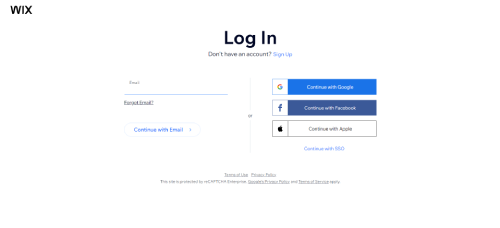
Go to Wix and sign into your account. You need at least one published site before you can use the Multilingual app. If you already have your site set up and are logged in, skip ahead to Step 2.
Step 2: Install the Wix Multilingual App

Open the Wix Editor and go to the Wix App Market. Search for "Wix Multilingual" and click "Add to Site." The app is free to install on any Wix plan, including free sites. Once installed, it integrates into your dashboard so you manage translations from one central place. This is one of the best Wix market apps for anyone targeting an international audience.
Step 3: Start the Setup Wizard
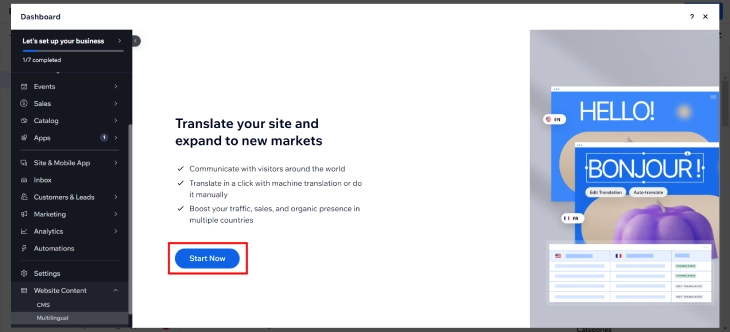
After installation, Wix takes you to the "Website Content" section. Click "Start Now" on the Multilingual panel. The wizard asks you to confirm your main language and pick your first secondary language. The whole wizard takes about two minutes.
Step 4: Confirm Your Main Language
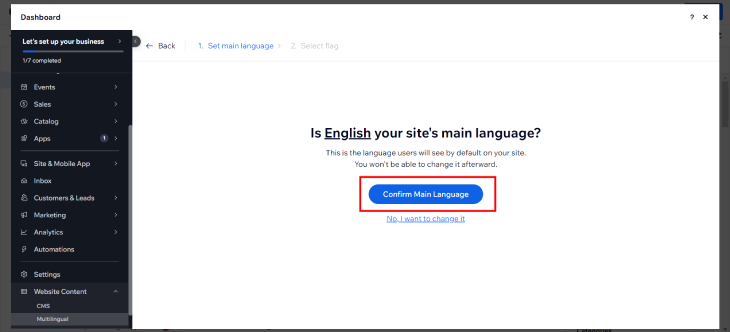
Wix defaults to English as the main language. If that is correct, confirm it. If your site is in another language, click "No, I want to change it" and pick the right one. This matters because your main language controls the default URL structure and which version Google treats as the primary page. Changing the main language later requires you to delete Wix Multilingual and start over, losing all existing translations. Double-check before moving on.
Step 5: Add a Secondary Language
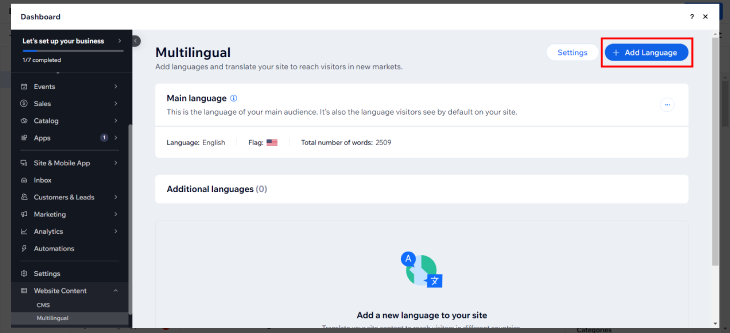
Click "Add Language" and pick from over 130 supported languages. Choose based on your actual traffic data. Open Wix Analytics and check which countries send visitors to your site. If 15% of your traffic comes from Brazil, Portuguese makes more sense than French. Start with one language, get it right, then add more. You can also select a flag icon to represent each language in the language switcher.
Step 6: Configure Translation Settings
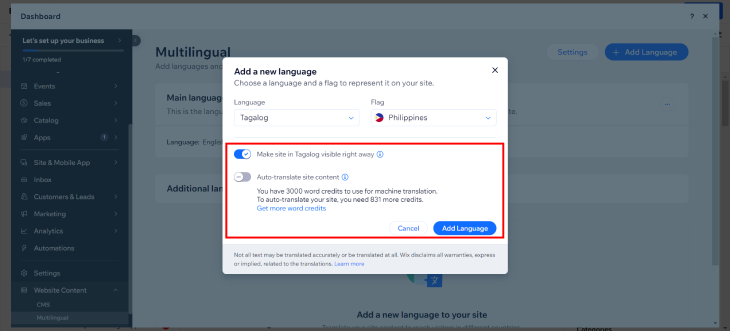
Wix gives you two toggle options when adding a language. The first controls whether the new language is visible on your live site immediately. Keep this off if you want to prepare translations before visitors see them. The second enables auto-translate, which uses machine translation powered by word credits. You can toggle auto-translate on for a quick first pass, then manually refine key pages later. Click "Add Language" to save, and your site officially supports multiple languages.
Translating Forms, Menus, and Dynamic Content
The setup wizard handles static page content, but Wix sites typically include forms, navigation menus, and CMS-driven dynamic pages. Each of these requires separate attention.
Forms
Wix Forms can be translated through the Multilingual dashboard, but with limitations. You can translate field labels, placeholder text, button text, and confirmation messages. However, some built-in elements like date field month names and default error messages cannot be manually edited. These follow your site's language settings automatically. If you use a form that collects data in multiple languages, test each language version to make sure the form submits correctly and the confirmation message displays in the right language.
Navigation Menus
Menu items are translatable through the Translation Manager. When you translate a menu item, the translation appears in that language version of your site. One thing to watch: if you add a new page to your menu after setting up Multilingual, you need to manually translate that menu item. It will not pick up a translation automatically.
CMS Dynamic Content
If your Wix site uses the CMS (Content Management System) with dynamic pages, translation works differently than static pages. You translate CMS collection content through the Translation Manager, but there are restrictions you should know about:
- Wix app collections (like Stores products or Bookings services) and Wix Forms collections are not eligible for CMS translation through the Multilingual dashboard
- Collections with more than 10,000 items cannot be translated
- New collections created after setting up Multilingual are not automatically added to the Translation Manager -- you must add them manually
- Dynamic page URLs are not translated. Instead, Wix prepends the language code, so
yoursite.com/products/item-namebecomesyoursite.com/fr/products/item-namerather than translating "products" or "item-name"
For sites with large CMS databases, plan your translation workflow before enabling Multilingual. Export your collections, identify which ones need translation, and budget time for manual review of auto-translated CMS content.
Wix Multilingual Pricing and Word Credits
The Wix Multilingual app is free to install. The costs come from auto-translation word credits and your overall Wix plan.
Free Credits
When you first enable Wix Multilingual, you receive 3,000 free word credits. Each credit equals one word translated by the machine translation engine (powered by Google Translate). A typical 500-word page uses 500 credits per language. So if you translate a 500-word page into three languages, that costs 1,500 credits. The 3,000 free credits can cover a small site with a handful of pages.
Buying More Credits
Once you run out of free credits, you purchase additional word credit packages through the Wix dashboard. Pricing scales with volume. A content-heavy site with blog posts, product descriptions, and landing pages will need significantly more credits than a five-page business site. Check the Wix App Market listing for current credit package pricing, as Wix adjusts rates periodically.
Ways to Reduce Translation Costs
- Translate manually for free. If you or someone on your team speaks the target language, type translations directly into the Multilingual dashboard at no cost
- Use the CSV export/import method. Export your content as a CSV file, send it to a freelance translator, and import the completed translations back into Wix. This avoids word credits entirely
- Prioritize pages. Auto-translate only your most important pages first. Skip translating archive pages, old blog posts, or low-traffic content until you confirm the language version is worth the investment
- Hybrid approach. Auto-translate for a first draft, then manually edit. This uses credits but saves time compared to translating from scratch
A Wix premium plan is required for features like connecting a custom domain, but the Multilingual app itself works on every plan tier, including free.
Auto-Translate vs Manual Translation
Choosing between auto-translate and manual translation is not all-or-nothing. Each method fits different situations.
When Auto-Translate Works Well
- Blog posts and informational content with straightforward language
- Product descriptions that use simple, factual text
- Sites translating into widely supported languages like Spanish, French, or German where machine translation quality is high
- First drafts that you plan to review and edit afterward
When Manual Translation Is Better
- Your homepage, sales pages, and landing pages where tone and persuasion matter
- Legal pages (terms of service, privacy policy) where accuracy is critical
- Content with idioms, humor, wordplay, or cultural references that machine translation mangles
- Languages where machine translation quality is lower, such as less common language pairs
- Industries with specialized terminology (medical, legal, technical) that generic translation engines handle poorly
Inviting Translators to Help
Wix lets you invite collaborators to translate your site. Go to your site's dashboard, create a custom role with translation permissions, and assign it to your translator. They get access to the Multilingual dashboard without being able to change your site's design or settings. This is useful if you are working with freelance translators or bilingual team members who do not need full admin access.
Multilingual SEO on Wix
Adding languages to your Wix site changes how search engines discover and serve your content. Get this right and each language version can rank independently in regional search results. Get it wrong and you end up with duplicate content problems or pages that never get indexed. Here is what to focus on for multilingual SEO on your Wix website.
Hreflang and X-Default Tags
Wix automatically adds hreflang tags to every translated page. These tags use ISO 639-1 language codes (like "fr" for French or "de" for German) and optional ISO 3166-1 region codes (like "en-US" for American English or "pt-BR" for Brazilian Portuguese). The tags tell Google which version of a page to display based on the searcher's language and location.
Wix also adds an x-default tag, which points to your main language version. This serves as the fallback when Google cannot match a searcher to any specific language version. You do not need to configure any of this manually -- the Multilingual app handles it.
URL Structure: Subdirectories
Wix uses the subdirectory approach for multilingual URLs. Your main language page stays at yoursite.com/page, and each additional language gets a prefix: yoursite.com/fr/page, yoursite.com/es/page, and so on. This is Google's recommended approach for multilingual sites because each URL is distinct, indexable, and shares domain authority with your main site. Wix does not support subdomains (like fr.yoursite.com) or separate domains (like yoursite.fr) for language versions.
Translating SEO Metadata
This is the step most Wix users skip, and it hurts their multilingual rankings. Each language version of a page needs its own translated meta title, meta description, and image alt text. In the Wix Multilingual dashboard, open the Translation Manager and look for the SEO fields for each page. Translate them with keywords that people actually search for in that language, not just a direct translation of the English keywords. For example, the French term people search for may differ from a literal translation of your English keyword.
Language Switcher and Crawlability
The Wix Multilingual app automatically adds a language switcher to your site. Place it in your header so it is visible on every page. This switcher is not just for visitors -- search engine crawlers use it to discover your language versions. If the switcher is hidden or broken, Google may not find all your translated pages. You can also enable the auto-switch language toggle, which redirects visitors to the language version matching their browser settings.
Handling RTL Languages (Arabic, Hebrew, Urdu)
Right-to-left (RTL) languages require extra attention because they flip your entire page layout horizontally. Text flows from right to left, and design elements mirror their positions.
What Wix handles automatically: When you add an RTL language, Wix reverses the text direction for all text elements. Paragraphs, headings, and list items align to the right edge by default.
What you need to check manually:
- Images with embedded text (like screenshots or infographics) will not flip. If your images contain English text, consider creating separate versions for RTL languages
- Navigation menus mirror their order. Verify that the flow still makes sense in the reversed layout
- Icons that imply direction (arrows, progress bars, forward/back buttons) may point the wrong way in RTL mode. Review these on every page
- CSS custom code may not respect the RTL flip. If you have added custom styling, test it in both LTR and RTL views
- Contact forms and input fields should show placeholder text aligned to the right
Wix Studio gives you more control over responsive breakpoints, which helps when fine-tuning RTL layouts for different screen sizes. After adding an RTL language, preview every page on desktop, tablet, and mobile before making it live.
How to Test Your Multilingual Wix Site Before Going Live
Translating your content is only half the job. Before you make a language version visible to the public, you need to verify that every piece of it actually works the way it should. The steps below cover what to check and how to check it properly, not just through the Wix Editor preview.
Step 1: Simulate the Visitor's Language Using Browser Settings
Change your browser's language to match the target language. In Chrome, go to Settings, then Languages, add the target language, and move it to the top of the list. Close and reopen the browser, then visit your site. If you have enabled the auto-language redirect in Wix Multilingual, your site should detect the browser language and load the correct version automatically. Confirm the right language appears on the homepage and at least two inner pages. If the redirect does not fire, check that the auto-switch toggle is turned on in your Multilingual settings.
Step 2: Validate Hreflang Tags with Google Search Console
Open the URL Inspection tool in Google Search Console and enter one of your translated page URLs. Under the "Indexing" section, look for "Hreflang." You should see one entry per language version, each pointing to the correct alternate URL. If the hreflang section is missing entirely, Wix may not have generated the alternate pages yet, which can happen if the language version was not published before you ran the inspection. If hreflang entries appear but the URLs look wrong (pointing to the homepage instead of the specific page, for example), re-check your Translation Manager to confirm that page's translation is published.
Step 3: Test All Form Submissions in Each Language
Switch your site to each language version and fill out every form on your site as if you were a real visitor. Check three things for each submission: the field labels appear in the correct language, the confirmation message after submitting appears in the correct language, and the form data actually arrives in your inbox or CRM. Pay special attention to notification emails. Wix sends form submission notification emails based on your main language settings by default. If you want your team to receive notifications in a different language, you need to set up separate automations for each language version. Missing this step means your Spanish-speaking visitor has a smooth form experience in their language while your team receives an English notification with no translation context.
Step 4: Check the Language Switcher on Every Page Type
The language switcher behaves differently depending on the type of page it is on. Test it on at least one page of each type your site uses:
- Static pages (About, Contact, Services) -- should switch directly to the translated version of that same page
- Blog posts -- should switch to the translated blog post, not redirect to the blog index
- Dynamic CMS pages -- should switch to the language-prefixed version of the same dynamic page
- Wix app pages (Stores, Bookings, Events) -- these have separate translation handling; confirm the switcher does not throw a 404 or redirect to the homepage
A switcher that works on your homepage but breaks on a product page is a common issue that only gets caught through manual testing.
Step 5: Test RTL Languages on a Real Mobile Device
The Wix Editor preview does not perfectly replicate how RTL languages render on mobile browsers. After adding Arabic, Hebrew, Urdu, or another RTL language, open that language version on an actual Android phone or iPhone. Check that: text flows right to left throughout the page, the navigation bar mirrors correctly with the logo and menu items in their expected positions, buttons and call-to-action elements point in the right direction, and any images with directional meaning (arrows, before/after comparisons, step-by-step diagrams) still make sense when the layout is flipped. Issues that look fine in the desktop editor often surface on mobile because the responsive breakpoints handle RTL mirroring differently.
Bonus step: After completing all five tests, reset your browser language back to English and clear your browser cache. Then visit your site again and confirm the auto-redirect fires correctly for English. Cached language preferences stored in your browser cookies can make the redirect appear to work even when it is actually broken for first-time visitors with no cookie history.
CJK Language Considerations (Chinese, Japanese, Korean)
Chinese, Japanese, and Korean (CJK) languages present unique challenges beyond simple translation.
Character width and spacing. CJK characters are typically wider than Latin letters, which means the same content may take up different amounts of space. However, CJK text often requires fewer characters to express the same meaning, so your translated pages may actually be shorter. Preview each page to check that text fits within buttons, headings, and fixed-width containers.
Font rendering. Not all fonts support CJK characters. If your Wix site uses a custom Latin font, the CJK text may fall back to a default system font, creating an inconsistent look. Test how your chosen fonts render CJK text and consider selecting a font that supports both Latin and CJK scripts.
Simplified vs Traditional Chinese. If you are targeting Chinese-speaking audiences, you need to choose between Simplified Chinese (used in mainland China and Singapore) and Traditional Chinese (used in Taiwan, Hong Kong, and Macau). These are different writing systems, not just regional variations. You may need to add both as separate languages with separate translations. In Wix, you can use region-specific hreflang tags like "zh-CN" for Simplified and "zh-TW" for Traditional.
Japanese writing systems. Japanese uses three scripts: Hiragana, Katakana, and Kanji. Auto-translate generally handles this well, but specialized terms and proper nouns may be transliterated incorrectly. Always have a native speaker review Japanese translations.
Korean line breaks. Korean text does not use spaces between all words the same way English does. Check that your translated Korean content wraps naturally within your layout without breaking words in odd places.
Wix Multilingual vs Third-Party Translation Apps
Before committing to the built-in Wix Multilingual app, it is worth understanding where it excels and where third-party alternatives fill gaps. The built-in app handles the technical infrastructure automatically, which makes it fast to deploy. But it has limitations that matter depending on your site type and translation volume.
Where Wix Multilingual Has the Advantage
- Zero-configuration hreflang and URL setup. Competitors and third-party tools often require manual configuration of these SEO elements. With Wix Multilingual, hreflang tags and subdirectory URLs are generated automatically with no code required.
- Native integration with all Wix apps. Blog, Stores, Bookings, and Events all work with the built-in app. Third-party solutions typically have partial or no support for Wix's native apps.
- Free for manual translation. If you have bilingual staff or work with an external translator, the only cost is their time. You pay only when you use the auto-translate word credits.
- Automatic language switcher. The switcher builds itself from your existing site design. No extra widget setup or custom code is needed.
Where Third-Party Tools Fill Gaps
- Weglot: The most widely used third-party translation tool for Wix. Weglot connects to your site via API and provides a professional translation management interface. It offers better auto-translation quality than Wix's Google Translate-based engine, supports professional translator hiring through its marketplace, and gives you glossary controls for brand-specific terms. It costs more per month than using Wix Multilingual credits, but the quality difference is noticeable for customer-facing content. Weglot is the better choice if translation quality is critical and budget allows.
- CSV-based external translation workflows. Wix lets you export your site content as a CSV file, which you can send to a professional translation management system (TMS) like Phrase or Lokalise, or directly to a translation agency. Completed translations import back into Wix. This approach bypasses word credits entirely and is the most cost-effective option for sites with large content volumes and professional quality standards.
- Manual HTML translation for simple sites. For very small sites (three to five pages), adding hreflang tags through Wix's custom code injection and duplicating pages manually is a valid workaround. It requires some technical knowledge but gives you full control without installing any app. This only makes sense for sites that will rarely change.
For most Wix users, the built-in Multilingual app is the right starting point. Consider switching to a more specialized tool only if you consistently run into its limitations at scale, primarily around translation quality for high-stakes content or complex CMS data structures.
How Wix Detects and Redirects Visitors to Their Language
When someone lands on your Wix site, the auto-language redirect feature can match them to the right language version automatically. Understanding how this detection works helps you configure it correctly and troubleshoot when it behaves unexpectedly.
How the Detection Works
Wix reads the visitor's browser language settings (the Accept-Language HTTP header sent with every web request) to determine their preferred language. If your site has a translated version that matches, Wix redirects the visitor to that language version. If there is no match, the visitor sees your main language version as the default.
This detection is based on browser language preference, not geographic location. A French speaker visiting from Canada sees the French version if you have one, even though Canada is an English-speaking country overall. A French speaker who has their browser set to English would see the English version. The system respects individual language preference rather than making assumptions based on where someone is physically located.
Enabling and Disabling Auto-Redirect
In your Wix Multilingual settings, look for the "Automatically redirect visitors to their browser language" toggle. When this is enabled, first-time visitors may land directly on a translated page without seeing your main language version first. When it is disabled, all visitors start on your main language page and must use the language switcher to change languages manually.
A middle option worth considering: enable redirect but pair it with a notification bar asking the visitor whether they want to switch languages. This approach is less disruptive than an automatic redirect and lets visitors confirm the language change before it happens. It works well for sites where some multilingual visitors may actually prefer the main language version.
What the Auto-Redirect Cannot Do
Wix Multilingual does not support country-based redirects. If you want to redirect everyone from Germany to a German-language version regardless of their browser language, Wix does not have a built-in tool for that. The detection is language preference only, not geolocation.
For true country-based routing, you would need one of the following approaches:
- Custom JavaScript via Wix Velo: In Wix Studio, you can write server-side Velo code that reads the visitor's IP-based location from a geolocation API and routes them accordingly. This requires development knowledge and a third-party geolocation service.
- A third-party geolocation redirect app: Some apps in the Wix App Market provide country detection and redirect functionality without custom coding. These connect to IP geolocation databases and can trigger language redirects based on detected country.
- Cloudflare or CDN-level rules: If your site is behind a CDN that supports geolocation-based routing, you can configure redirect rules at that layer without modifying your Wix site directly. This is an advanced option for sites that need highly reliable country-based routing at scale.
For most sites, browser language detection covers the majority of use cases. Visitors who set their browser language correctly get the right experience automatically. Only invest in country-based routing if you have a specific business reason, such as serving legally distinct content to users in certain jurisdictions.
Common Wix Multilingual Mistakes
After working with Wix Multilingual, these are the mistakes that cause the most problems. Avoid them from the start.
Forgetting to translate automated emails. If your Wix site sends automated emails (order confirmations, booking reminders, contact form notifications), those emails default to your main language. You need to set up separate email automations for each language. A French-speaking customer who receives an English confirmation email gets a poor experience.
Not adding new CMS collections to the Translation Manager. When you create a new CMS collection after Multilingual is already set up, Wix does not automatically include it in the Translation Manager. You must add it manually. If you skip this step, the new collection's content will not be translatable.
Repositioning elements in a secondary language. If you move a design element (like a text box or image) while viewing a secondary language in the editor, that change applies to all language versions. This is a common source of broken layouts. Make position changes in your main language version only.
Skipping SEO metadata translation. Translating page content but leaving meta titles and descriptions in English means Google has no language signal for those fields. Each language version needs its own translated metadata with relevant keywords in that language.
Publishing untranslated pages. If you make a language visible before all pages are translated, visitors will see a mix of translated and untranslated content. Wix displays the main language version for any untranslated sections, which looks unprofessional. Keep new languages hidden until translations are complete.
Ignoring text expansion. German text runs about 30% longer than English. Finnish can be even longer. After translating, preview every page to check that buttons, headings, and navigation items are not cut off or overflowing their containers.
Trying to change the main language later. Wix does not let you swap your main language once Multilingual is active. To change it, you must delete the Multilingual app entirely and reinstall it, which erases all existing translations. Pick the right main language from the start. If you are unsure, duplicate your site first as a backup.
Tips for Managing a Multilingual Wix Site Long-Term
Setting up is the easy part. Keeping a multilingual site running well over time takes consistent effort.
- Sync content updates across languages. When you update a page in your main language, the translated versions do not update automatically. Build a process: every time you edit your primary content, flag those pages for re-translation
- Track performance by language. Use Wix Analytics or connect Google Analytics to see which language versions get traffic and conversions. If your Spanish pages get 10x the traffic of your Italian pages, invest more translation effort into Spanish
- Test the language switcher regularly. Check that it works on every page type (homepage, blog posts, dynamic pages, product pages) and that it remembers the visitor's language choice as they browse
- Audit translations quarterly. Machine-translated content degrades your brand if left unreviewed. Set a quarterly reminder to read through your highest-traffic translated pages and fix any awkward phrasing
- Add languages based on data, not guesses. Use your analytics to identify which countries send real traffic before investing in a new language. Translating into a language none of your visitors speak wastes time and credits
Adding multiple languages to your Wix site opens your content to audiences who would otherwise bounce because your site is not in their language. The Wix Multilingual app handles the technical parts: hreflang tags, URL structures, and the language switcher. Your job is choosing the right languages, translating content accurately, and keeping everything updated as your site grows. Start with your highest-impact language, get the translation quality right, and expand from there.
* read the rest of the post and open up an offer