

Wix has built one of the most recognisable names in website building by offering a platform that anyone can use for free. Its drag-and-drop editor, hundreds of templates, and beginner-friendly setup have attracted over 250 million registered users worldwide. A platform that size costs significant money to run, so understanding how Wix makes money reveals a business model far more sophisticated than a simple subscription service.
This post breaks down the Wix revenue model and business model in full, covering every significant income stream the company relies on in 2026.
How Does Wix Make Money? The Full Revenue Model
With over 250 million users worldwide, Wix has built a diversified revenue model that goes well beyond simple subscriptions. Understanding the Wix business model shows just how many income layers the company has developed. Here is every major way Wix earns money:
1. Wix Freemium Model
Wix's primary revenue engine is the freemium business model. Users can create and host a website for free, but the free plan comes with Wix-branded ads displayed on the site, limited storage, and no custom domain. These limitations push a meaningful percentage of users to upgrade to a paid plan, which is exactly how the Wix pricing model is designed to work.
The free tier functions as the top of the funnel: it attracts tens of millions of users at low cost to Wix, then converts a percentage into paying subscribers. Even a small conversion rate across hundreds of millions of users generates substantial subscription revenue.
2. Wix Premium Plans
Premium plan subscriptions are the backbone of the Wix revenue model. Wix's current pricing has been significantly restructured. The old plan names (Connect Domain, Combo, Unlimited, VIP) have been retired and replaced with a cleaner tier structure that now includes eCommerce features across all paid plans.
Here is an overview of the current 2026 Wix pricing plans:
Light | Core | Business | Business Elite | |
Price | $17 per month | $29 per month | $36 per month | $159 per month |
Key Features | Custom Domain Remove Wix Ads 2 GB Storage Free Domain for 1 Year Basic SEO Tools | All Light Features 50 GB Storage Accept Online Payments 5 Hours Video Basic eCommerce | All Core Features 100 GB Storage 10 Hours Video Advanced eCommerce Subscriptions & Plans | All Business Features Unlimited Storage Unlimited Video Advanced Automations Priority Support |
Best For | Personal sites and portfolios | Small businesses starting to sell online | Growing eCommerce businesses | High-volume stores and agencies |
Each plan upgrade represents incremental recurring revenue for Wix. The jump from Business ($36/month) to Business Elite ($159/month) in particular shows the premium Wix places on its highest-value customers.
3. Wix eCommerce and Transaction Fees
Wix eCommerce is built into the Core plan and above, giving merchants the tools to run a full online store: secure payments, customizable shipping, tax management, and sales analytics. But the more significant revenue stream here is not the plan fee itself. It is transaction fees through Wix Payments.
Wix Payments is Wix's native payment processor. When merchants use Wix Payments to accept orders, Wix earns a percentage of every transaction processed. Standard rates run at 2.9% + $0.30 per transaction for card payments in the US, directly in line with major payment processors. With millions of active Wix stores processing sales daily, this payment processing revenue has become a material part of the Wix revenue model.
Merchants who choose third-party payment gateways instead of Wix Payments may also pay an additional transaction fee to Wix on some plans, providing a further revenue layer.
4. Wix Marketing Tools
Wix Marketing Tools (formerly known as Wix Ascend) is Wix's suite of business growth and customer management features. It includes email marketing campaigns, automated workflows, CRM (customer relationship management), SEO tools, live chat, invoicing, and social media post scheduling.
Many of these tools are available in limited form within premium plans, but advanced usage such as larger email send volumes, more automations, or expanded CRM contacts requires upgrading to higher-tier plans or purchasing Marketing Tools add-ons. This creates an additional upsell path that contributes meaningfully to Wix's overall revenue.
5. Wix App Market
The Wix App Market is a marketplace where third-party developers create and sell applications that integrate directly into Wix websites. With over 500 apps available, users can add live chat, booking systems, loyalty programs, social media feeds, and hundreds of other functionalities.
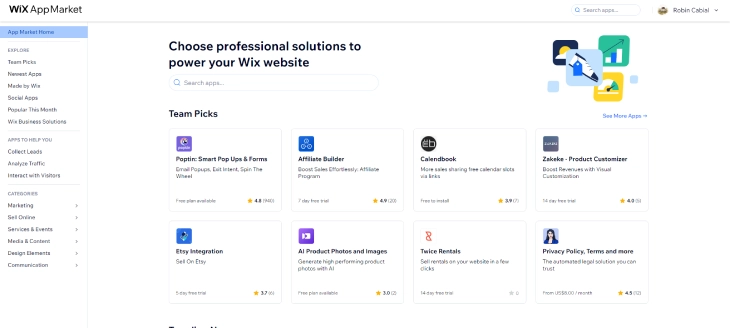
Wix earns revenue from the App Market by taking a commission on all paid app sales and subscriptions. The standard split is 70% to the developer and 30% to Wix. With hundreds of thousands of users installing apps, this commission revenue compounds significantly at scale. The App Market also increases platform stickiness, making it harder for users to leave Wix once they have configured multiple app integrations.
6. Wix AI Site Builder
Wix's AI Site Builder (which replaced the older Wix ADI tool) uses artificial intelligence to generate a complete, personalized website from a short text prompt or a series of guided questions. The AI builds out the site structure, selects relevant design elements, and pre-populates content, dramatically reducing the time it takes a new user to launch a website.
The AI Site Builder is available to all users, including those on the free plan, but the resulting site still requires a premium plan to connect a custom domain and remove Wix branding. This means the AI tool functions as a powerful acquisition and activation driver: it reduces friction for new users, gets them to a working site quickly, and then presents the upgrade prompt at exactly the right moment, when the user already has a site they want to publish properly.
7. Wix Domain Name Registration
Wix generates direct revenue through domain name registration. Users can purchase and register a domain name through Wix, renewing it annually. All paid plans include one free domain for the first year, after which renewal fees apply. Users who already own a domain can connect it to Wix, but many choose the convenience of purchasing through Wix directly, making domain registration a reliable recurring revenue line.
Here is an overview of current Wix domain pricing:
1 Year | 2 Years | 3 Years | |
.com Price | $14.95 per year | $13.95 per year | $12.95 per year |
.webp)
8. Wix Enterprise
For large organizations, agencies, and brands managing multiple sites at scale, Wix offers Wix Enterprise: a custom, high-touch tier with dedicated account management, advanced security, SLA guarantees, and bespoke onboarding. Enterprise contracts are priced individually and can represent significant annual contract values far above the standard Business Elite plan.
The Enterprise segment is an increasingly important part of Wix's revenue strategy as the company moves up-market. Major brands using Wix for their web presence generate significantly more revenue per account than individual users, and they also provide reputational credibility that attracts more enterprise clients.
9. Advertising and the Partner Program
Wix uses its large user base to generate revenue through advertising and strategic partnerships. On free plan websites, Wix displays its own branded banner ads. These serve a dual purpose: they generate direct advertising value and they incentivize free users to upgrade to remove them.
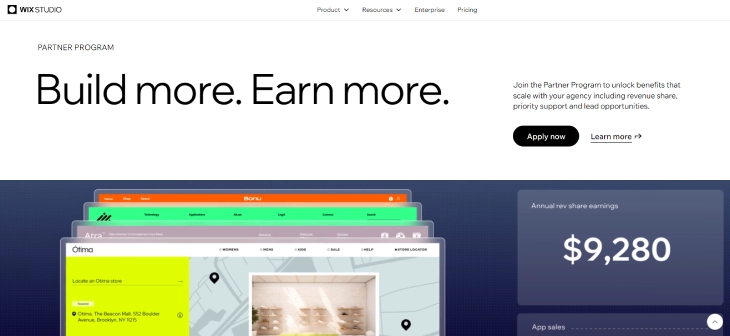
The Wix Partner Program allows web designers, developers, and agencies to build and manage client sites on Wix in exchange for volume-based discounts and revenue sharing. Partners who refer clients to Wix plans earn commissions through the Wix affiliate program, while Wix benefits from an expanded distribution network of professionals actively selling Wix-powered solutions.
Wix Studio: A Separate Revenue Tier
One part of Wix's revenue model that is easy to overlook is Wix Studio, the company's professional-grade editor aimed specifically at agencies, freelancers, and web designers who build sites for clients.
Wix Studio is a distinct product from the standard Wix editor. It offers a more advanced design interface with CSS-level control, responsive breakpoints, and a workspace designed for managing multiple client projects. The subscription pricing for Wix Studio sits in its own tier structure, separate from the consumer-facing Light, Core, Business, and Business Elite plans.
For Wix, Studio is a strategically important revenue stream for three reasons:
- Higher contract values: Agencies and professional designers who subscribe to Wix Studio tend to manage many client sites, which means Wix earns recurring revenue from each site under management rather than from just one subscriber.
- Lower churn: Professional users who build client workflows around Wix Studio are far less likely to switch platforms than individual users. The switching cost is substantially higher.
- Up-market positioning: Wix Studio gives the company credibility among professional designers who previously dismissed Wix as a consumer tool, opening a segment that has historically gone to WordPress or Webflow.
As Wix grows its Studio user base, this segment is expected to become a more meaningful contributor to overall revenue, particularly as client sites built on Studio generate their own subscription and transaction fee income.
How Wix Uses AI to Drive Revenue
Wix has made artificial intelligence a central part of its product strategy, and the revenue implications go well beyond any single AI feature.
The AI Site Builder is the most visible tool: it generates a complete website from a text prompt in minutes. But Wix has also rolled out an AI text generator (which writes and rewrites copy directly within the editor), AI image generation (which creates custom visuals without leaving the platform), and AI-powered SEO recommendations that suggest meta titles, descriptions, and keyword improvements automatically.
Each of these tools plays a specific role in Wix's revenue model:
- Reducing time-to-publish: When users can go from sign-up to a working site in minutes, they are far more likely to stay on the platform and eventually upgrade. The AI tools shorten the gap between "I want a website" and "I have a website I want to keep."
- Reducing early churn: Many users abandon website builders early because building feels too slow or difficult. AI tools address this directly, keeping users engaged long enough to see value in upgrading.
- Creating upgrade moments: The AI text generator and image tools are limited on lower-tier plans. Heavy users who want more AI credits or higher usage limits are nudged toward Business or Business Elite plans, where these tools are more accessible.
- Differentiating from competitors: AI features are now a key part of how Wix positions itself against Squarespace and WordPress, and strong AI tooling is increasingly a reason users choose Wix rather than an alternative.
The result is that Wix's AI investment pays off not just as a product feature, but as a conversion and retention driver that directly improves the economics of the freemium model.
Wix Revenue by the Numbers
The scale of the Wix business model becomes clearer when you look at the actual figures behind it:
- Annual revenue: Wix reported approximately $1.76 billion in revenue for 2024, up from $1.54 billion in 2023, reflecting consistent double-digit year-over-year growth.
- Q1 2025 performance: Wix's Q1 2025 results showed continued momentum, with the company reporting revenue growth in the high single digits year-over-year and reaffirming its full-year guidance, a signal that the business is growing predictably rather than slowing.
- Premium subscribers: As of early 2025, Wix had approximately 6.8 million premium subscribers, the paying customers who generate the bulk of the company's revenue.
- Free user base: With over 250 million registered users and roughly 6 to 7 million paying, Wix's conversion rate from free to paid sits at approximately 2 to 3%, a figure that is typical for freemium SaaS platforms at scale.
- Payments revenue: Business Solutions revenue (which includes Wix Payments transaction fees and other merchant services) has grown to represent roughly 30% of total revenue, up significantly as more Wix stores go live and process sales.
- Stock listing: Wix is publicly traded on NASDAQ under the ticker WIX, giving it access to capital markets and subjecting it to regular financial reporting, which is why detailed revenue data is publicly available.
These numbers illustrate a key point about the Wix revenue model: the freemium base is enormous, but the actual revenue is generated by a relatively small paying tier and an increasingly significant payments processing layer.
How Wix's Revenue Model Compares to Squarespace and Shopify
Wix is not the only platform monetising website builders at scale. Here is how its approach differs from its two closest competitors:
| Revenue Stream | Wix | Squarespace | Shopify |
|---|---|---|---|
| Free plan | Yes (permanent free tier) | No (14-day trial only) | No (3-day trial, then paid) |
| Subscription plans | $17–$159/month | $16–$99/month | $29–$299/month |
| Transaction fees | Via Wix Payments (2.9% + $0.30) | 0–3% + payment processor fees | 0.5–2% + payment processor fees |
| App marketplace cut | ~30% of app revenue | Not applicable (no public marketplace) | ~20% of app revenue |
| Primary customer profile | Individuals, SMBs, agencies | Creatives, SMBs | eCommerce businesses of all sizes |
| Enterprise offering | Yes (Wix Enterprise) | Yes (Enterprise plan) | Yes (Shopify Plus) |
The key structural difference is that Wix monetises through volume at the low end (a permanent free tier that generates enormous top-of-funnel traffic) while Squarespace and Shopify charge from day one. Shopify's model is more commerce-focused. Its transaction fee revenue from millions of active stores dwarfs Wix's payment processing income. But for general website building, Wix's freemium approach has proven effective at scale.
Is Wix Profitable?
Wix has grown from a free website builder into a publicly traded company (NASDAQ: WIX) with over $1.7 billion in annual revenue. The Wix business model is designed for high recurring revenue: the vast majority of Wix's income comes from subscriptions that renew monthly or annually, giving the company predictable cash flows.
Wix achieved GAAP profitability milestones in 2023 and has continued to improve its operating margins as the business matures. The shift toward Wix Payments as a revenue source has been particularly important. Transaction fee income scales with merchant sales volume rather than being capped by the number of subscribers, giving Wix a meaningful growth lever beyond plan upgrades. While Wix is genuinely free to start, the free tier is essentially an acquisition channel that feeds a subscription funnel generating billions of dollars per year.
How Wix Payments Earns Revenue as a Payment Facilitator
Most coverage of the Wix revenue model treats Wix Payments as a simple transaction fee line. The actual mechanism is more specific, and understanding it explains why Wix has invested so heavily in building its own payment infrastructure rather than reselling a third-party processor.
Wix operates Wix Payments as a payment facilitator (PayFac). This means Wix holds a direct relationship with card networks (Visa, Mastercard, American Express) and underwrites its merchants under its own master merchant account. As the PayFac, Wix collects the full processing rate from merchants and retains the spread above the interchange fee it owes to the card network.
Here is what the economics look like on a typical $100 US card transaction:
- Wix Payments collects $3.20 from the merchant (2.9% + $0.30)
- Wix pays the card network an interchange fee, which for a standard US consumer credit card runs roughly 1.5% to 2.0%
- Wix retains approximately $1.00 to $1.50 per $100 as gross margin on the transaction
With millions of Wix stores processing sales daily, those per-transaction margins accumulate into a material revenue line. Business Solutions revenue (the segment that includes Wix Payments) represented approximately 30% of total Wix revenue by 2024, and it is growing faster than the subscription segment.
Beyond standard card processing, Wix Payments also generates revenue through:
- POS hardware sales: Wix sells card readers for in-person transactions at retail price, generating upfront device revenue. In-person transaction rates (2.6% + $0.10 per tap or dip) are lower than online rates but still contribute to the overall payment revenue pool.
- Currency conversion: International merchants who receive payments in a different currency than their payout currency incur a conversion markup, adding a further revenue layer for Wix.
- Third-party gateway fees: Merchants who opt for a non-Wix payment provider on certain plans pay an additional platform transaction fee to Wix, which acts as a financial incentive to use Wix Payments and generates supplemental income when merchants choose not to.
One important clarification: when Wix markets Wix Payments as a "0% transaction fee" option, this refers to the absence of a separate Wix platform fee on top of the processing rate. Wix's revenue comes from the processing rate itself. The distinction matters for merchants comparing true costs across payment options.
The Wix Agency and Reseller Ecosystem
One of the less visible but structurally important parts of the Wix revenue model is the agency and reseller network Wix has built around its platform. Rather than relying solely on direct user acquisition, Wix has turned professional web designers, digital agencies, and freelancers into an extended distribution channel.
The Wix Partner Program organizes these professionals into tiers based on the volume of premium plans they manage and sell. Higher tiers unlock larger revenue sharing on client plans, priority access to Wix support, co-marketing opportunities, and early feature access. The structure creates a financial incentive for agencies to grow their Wix-based client base rather than diversifying across platforms.
The commercial logic for Wix is straightforward. A single agency that standardizes on Wix for client work can bring 10, 20, or even 50 client sites to the platform. Each of those sites pays its own monthly plan subscription. Wix acquires all of that recurring revenue through one agency relationship rather than spending acquisition budget on each client individually. When an agency migrates to Wix Studio as their primary build environment, Wix gains even more, since every existing client project the agency manages now generates Studio plan revenue.
For larger agencies and enterprise clients, Wix also offers white-label and custom arrangements where the platform is presented under the agency's own branding. These deals are negotiated directly and represent some of the highest contract values in the Wix revenue model, sitting well above even the standard Business Elite pricing. Each successful white-label deployment also anchors the agency more deeply to Wix's infrastructure, making future platform changes increasingly costly for the agency to consider.
How Wix's International Markets Drive Revenue
Wix is registered in Israel and listed on NASDAQ, but it operates as a genuinely global platform. The service runs in over 190 countries, supports more than 20 languages, and publishes its interface and pricing in multiple local currencies. International revenue is a meaningful and growing share of Wix's total, and the company's approach to global monetization has several distinct layers.
Wix does not break out revenue by geography in detail in its public filings, but the company has consistently noted that a substantial portion of premium subscribers come from outside the United States. European markets (particularly Germany, France, and the United Kingdom), along with Brazil, India, and Japan, represent large active user bases that contribute materially to subscription revenue.
Localized pricing plays an important role in international monetization. Wix adjusts plan prices for different markets, setting rates in local currencies at levels that reflect purchasing power and competitive conditions in each region. This means Wix can acquire subscribers in markets where US dollar pricing would price most users out, converting international free users into paying customers at locally appropriate rates.
The multilingual editor is also a quiet revenue driver in international markets. Site owners who want to publish content in multiple languages from a single Wix account need a paid plan, and managing multilingual sites adds enough complexity that these users are far less likely to downgrade or switch platforms. Countries with high multilingual publishing rates (much of Europe and Latin America) thus skew toward longer-tenure, higher-spend subscribers.
Finally, the international expansion of Wix Payments adds transaction fee revenue from each new market where the product launches. Wix Payments was initially available only in the United States. By 2026, it has expanded to over 25 countries. Each new country added to the Wix Payments footprint opens a new population of merchants who can now generate transaction fee revenue for Wix, compounding the payment processing income that is already the company's fastest-growing revenue segment.
Wix's Revenue Model: Why It Works at Scale
The Wix revenue model is built on multiple overlapping income streams that reinforce one another. At its core, the Wix pricing model converts free users into premium subscribers. But the full picture is far richer: Wix Payments adds transaction fee income on every sale processed through its stores. The App Market generates commissions at scale. Domain registration and AI site-building tools drive activation and retention. Wix Studio captures the professional and agency market. Marketing Tools and Enterprise contracts bring in the highest-value segments.
Together, these revenue streams explain how a platform that lets anyone build a website for free has grown into one of the most successful SaaS companies in the website builder industry. The freemium entry point is the hook; the diverse upgrade paths and value-added services are what turn Wix into a multi-billion dollar business. To understand what the free entry point actually includes, see our breakdown of what the Wix free plan covers.
* read the rest of the post and open up an offer