

Meta tags on Wix fall into two categories: the standard title and description tags that Wix handles through its basic SEO settings, and custom meta tags you add manually through the Advanced SEO tab. Most Wix users only ever need the first type - Wix sets them up for you when you fill in the SEO fields on each page. The Advanced SEO tab is for specific technical additions like Open Graph tags, custom robots directives, or structured data that Wix doesn't generate automatically.
This guide covers both approaches: how to use Wix's native SEO fields for title and description meta tags, and how to add custom meta tags on Wix using the Additional Tags section in the Advanced SEO panel. It also includes tips for making the most of each tag type.
What Types of Meta Tags Can You Add to Wix?
Wix supports several categories of meta tags, each with a different purpose:
- Meta title and meta description: These are the most important for SEO - they control what appears in Google search results. Wix lets you set these natively for every page under SEO Basics without touching any HTML code.
- Open Graph tags (og:title, og:description, og:image): These control how your page appears when shared on Facebook, LinkedIn, and other social platforms. Wix generates basic OG tags automatically from your page title and social share image settings, but you can customise them via the Additional Tags field if needed.
- Twitter/X Card tags: Similar to OG tags but specific to X (formerly Twitter). Add these manually via Additional Tags if your social share preview on X needs specific customisation.
- Robots meta tags: Tell search engines whether to index a page and follow its links. Wix includes robots settings (index/noindex, follow/nofollow) directly in the Advanced SEO tab - you don't need to add these manually.
- Viewport meta tag: Controls how the page renders on mobile devices. Wix adds this automatically - you do not need to add it manually.
- Custom/additional meta tags: Any HTML meta tag not covered by the above that you want to add for a specific tool, verification code, or schema - for example, a Google Site Verification tag or a custom Pinterest rich pin tag.
When Do You Need Custom Meta Tags vs Wix's Native SEO Fields?
For most Wix sites, the native SEO settings (Page Info and SEO Basics tabs) are sufficient. You only need to use the Additional Tags field in Advanced SEO when:
- You need to add a site verification code (e.g., Google Search Console verification via meta tag rather than DNS)
- A third-party tool like Pinterest, a social platform, or an analytics service requires a specific meta tag to activate its features
- You need a custom Open Graph image for a page whose social share image differs from the page's main image
- You want to add JSON-LD structured data for rich snippets (events, products, FAQs) that Wix doesn't generate automatically for that content type
If you just want to set your page title, meta description, or control indexing, you don't need Additional Tags at all - those are handled in the standard SEO Basics panel.
Step-by-Step Guide to Adding Meta Tags on Wix
The steps below cover how to add custom meta tags through the Advanced SEO tab in the Wix Editor - useful for the specific technical use cases described above.
Step 1: Click 'Pages' on the Wix Editor Menu

In your Wix Editor, look for the 'Pages' icon on the upper left-hand side of the screen. It looks like a paper with 2 horizontal lines in the middle. Click on it to display a list of all the pages on your site.
Step 2: Click the 'More Actions' Icon Next to the Relevant Page

Scroll through the list of pages and select the page you want to add a meta tag to. Click the 'More Actions' icon (three dots: '...') beside your chosen page to open a dropdown menu.
Step 3: Click 'SEO Basics'
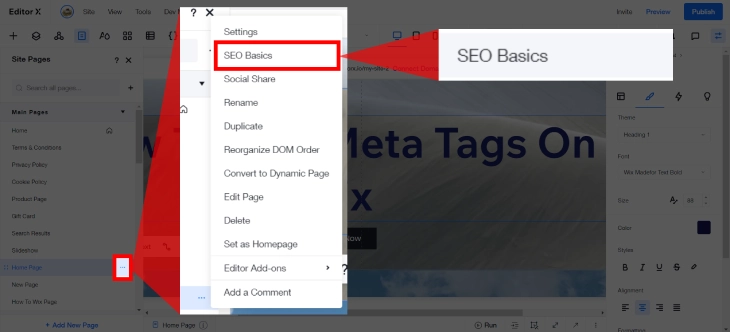
From the dropdown menu, click 'SEO Basics'. This opens the SEO settings panel for the selected page.
Step 4: Click the 'Advanced SEO' Tab

A window will appear with 5 different tabs - Page info, Permissions, SEO Basics, Advanced SEO, and Social share. Click the 'Advanced SEO' tab. This is where you'll find options for structured data markup, robots meta tags, and additional tags where you can add keywords and custom meta tags.
Step 5: Select 'Additional Tags' and Click 'Add New Tag'

Click the 'Additional Tags' section to expand it, then click 'Add New Tag'. A text field will appear where you can enter your custom meta tag in HTML format.
Step 6: Add Your Meta Tag Code

Enter your meta tag code in the text field. Add only one tag at a time and make sure it is in valid HTML format. For example, a Google Site Verification tag would look like this:
<meta name="google-site-verification" content="YOUR_VERIFICATION_CODE" />
An Open Graph image tag would look like this:
<meta property="og:image" content="https://yourdomain.com/image.jpg" />
Click 'Apply' once you have added the tag. Wix will validate the HTML - if there is an error, check that the tag is properly formatted with opening and closing angle brackets and quotes around attribute values.
Open Graph and Twitter Card Meta Tags: Practical Examples
Open Graph tags control how your pages appear when shared on social media. Wix auto-generates basic versions from your page title and social share image, but you may need to override them for specific pages (like a promotional landing page or a product page with a different image).
Here are the most commonly needed OG tags and what each one does:
- og:title - The title that appears in the social share card. If you leave this out, Facebook and LinkedIn will pull your page title instead. Useful when your page title is SEO-optimized but you want a shorter or punchier title for social sharing.
- og:description - The summary text that appears below the title in the share card. Keep it to 120-155 characters. This is separate from your meta description.
- og:image - The image that appears in the share card. Recommended size: 1200x630 pixels (1.91:1 ratio). If you don't specify this, the platform will pick any image on the page or fall back to your default.
- og:type - Usually "website" for static pages or "article" for blog posts.
Example of a complete Open Graph block for a Wix page (add each line as a separate Additional Tag):
<meta property="og:title" content="Your Page Headline Here" />
<meta property="og:description" content="A short description of what visitors will find on this page." />
<meta property="og:image" content="https://yourdomain.com/path/to/image.jpg" />
<meta property="og:type" content="website" />
For Twitter/X, replace the og: prefix with twitter: and add a card type:
<meta name="twitter:card" content="summary_large_image" />
<meta name="twitter:title" content="Your Page Headline Here" />
<meta name="twitter:description" content="A short description for X." />
<meta name="twitter:image" content="https://yourdomain.com/path/to/image.jpg" />
Structured Data: Meta Tags for Rich Results
Structured data is the most powerful type of custom meta tag you can add to Wix pages. It is written in JSON-LD format and placed in a <script> tag (added via the Additional Tags field). It tells Google specific things about your content, enabling rich results like star ratings, FAQ dropdowns, event dates, and product prices directly in search.
Wix generates some structured data automatically for certain content types (like Wix Stores products or Wix Blog posts), but many page types have no auto-generated schema at all. You need to add it manually.
FAQ Schema: Adding a Dropdown FAQ to Search Results
If your page includes a Frequently Asked Questions section, adding FAQ schema can get your questions to expand directly in Google search results, taking up more real estate and improving click-through rates.
<script type="application/ld+json">
{
  "@context": "https://schema.org",
  "@type": "FAQPage",
  "mainEntity": [
    {
      "@type": "Question",
      "name": "Your first question here?",
      "acceptedAnswer": {
        "@type": "Answer",
        "text": "The answer to the first question. Be specific and complete."
      }
    },
    {
      "@type": "Question",
      "name": "Your second question here?",
      "acceptedAnswer": {
        "@type": "Answer",
        "text": "The answer to the second question."
      }
    }
  ]
}
</script>
Add this as a single entry in the Additional Tags field. Paste the entire block and click Apply.
LocalBusiness Schema: Helping Google Show Your Business Info
If your Wix site represents a local business (a restaurant, salon, law firm, or retail shop), LocalBusiness schema helps Google display your name, address, phone number, and hours in search results and Google Maps.
<script type="application/ld+json">
{
  "@context": "https://schema.org",
  "@type": "LocalBusiness",
  "name": "Your Business Name",
  "address": {
    "@type": "PostalAddress",
    "streetAddress": "123 Main Street",
    "addressLocality": "Your City",
    "addressRegion": "State",
    "postalCode": "12345",
    "addressCountry": "US"
  },
  "telephone": "+1-555-000-0000",
  "url": "https://yourdomain.com",
  "openingHours": "Mo-Fr 09:00-17:00"
}
</script>
Article Schema: For Wix Blog Posts
Wix Blog posts receive some auto-generated schema, but adding Article schema manually ensures the correct author, date, and headline are communicated to Google. This can help blog posts qualify for news carousels and article rich results:
<script type="application/ld+json">
{
  "@context": "https://schema.org",
  "@type": "Article",
  "headline": "Your Blog Post Title Here",
  "author": {
    "@type": "Person",
    "name": "Author Name"
  },
  "datePublished": "2026-01-15",
  "dateModified": "2026-06-10",
  "publisher": {
    "@type": "Organization",
    "name": "Your Site Name",
    "logo": {
      "@type": "ImageObject",
      "url": "https://yourdomain.com/logo.png"
    }
  }
}
</script>
How to Test Your Structured Data
After adding any JSON-LD to a Wix page, test it before considering the work done. Google's Rich Results Test (search "Google Rich Results Test") lets you paste a URL and see whether Google can detect the schema and whether it qualifies for rich results. If there are errors, the tool will tell you exactly which field is missing or incorrectly formatted. Fix those errors and retest until the schema is clean.
Common Meta Tag Mistakes on Wix
These are the most common meta tag errors that hurt Wix site rankings, many of which you can fix in under five minutes:
- Duplicate meta titles across pages. Every page needs a unique title. When multiple pages share the same meta title, Google has trouble distinguishing between them and may rank neither. Go through your pages in the Wix Pages panel and confirm each has a distinct title.
- Meta descriptions longer than 160 characters. Google truncates descriptions that run too long. Keep them at 120-155 characters. Longer descriptions are not penalized, but the truncated version is what searchers see, and a mid-sentence cutoff reduces click-through rates.
- Leaving the default Wix meta description on every page. Wix sometimes pre-fills a generic description when you create a page. Check that every page has a description you wrote specifically for that page and its target keyword.
- Adding the robots noindex tag to pages you want indexed. The Additional Tags field accepts any HTML, including a noindex tag. If you experiment with this and leave it in place, Google will stop indexing that page. Always double-check that pages you want Google to rank are not accidentally noindexed.
- Adding Open Graph tags without uploading an OG image to the right size. An og:image that points to a small image (under 600 pixels wide) may be ignored by Facebook and LinkedIn. Use a 1200x630 pixel image specifically uploaded for social sharing.
- Adding malformed JSON-LD structured data. A missing comma, unclosed bracket, or unescaped special character in your JSON will break the entire schema block silently. Use Google's Rich Results Test to validate every schema addition before publishing.
Tips for Optimising Meta Tags on Wix
Meta tags are an important part of on-page SEO. Here are the strategies that make the biggest difference for Wix sites:
Write Unique Title Tags for Every Page
Your meta title is the headline that appears in Google search results. Make it informative and specific - ideally under 60 characters - and include your primary keyword naturally. Each page on your Wix site should have a different title tag. Duplicate titles confuse search engines about which page to rank for a given query.
Write Compelling Meta Descriptions
Meta descriptions appear below the title in search results and directly influence whether someone clicks through. Keep them between 120-160 characters, include your target keyword, and describe the specific value the page offers. Think of the description as a one-sentence argument for why a searcher should choose your page over the others they are scrolling past.
Use Keywords Naturally
While Wix doesn't rely on keyword meta tags for ranking (those are obsolete), your title tag and meta description should include your target keyword - placed naturally, not forced. Conduct keyword research to identify the exact phrases your audience uses, then integrate keywords throughout your Wix site including your titles and descriptions.
Optimise Alt Text for Images
Alt text serves two functions: it helps screen readers describe images to visually impaired users, and it gives search engines context about what your images depict. Add specific, descriptive alt text to every image on your Wix pages. Avoid phrases like "image of" or "photo of" - describe what is actually shown and why it is relevant to the page.
Review and Update Meta Tags Regularly
Search engines reward pages that stay current. When you update your page content, revisit the meta title and description to make sure they still accurately reflect what the page covers. Pages that fall in rankings often have stale meta tags that no longer match the search intent for their target keywords.
Getting Your Meta Tags Right on Wix
For most Wix pages, the title and meta description in the SEO Basics tab are the only meta tags you need to set. The Additional Tags field in Advanced SEO is specifically for technical use cases - site verification codes, custom OG tags, or JSON-LD structured data. For example, if you want to display star ratings in Google results, you can embed Google reviews on your Wix site and add the corresponding schema markup through this tab. Getting the basics right first (unique title, specific description, target keyword) will have a much greater impact on your rankings than adding custom tags. Once your meta tags are in place, you will want to track your Wix site's analytics to see whether your changes are improving click-through rates and search visibility over time.
Once your meta tags are in place, connect your site to set up proper 301 redirects on Wix for any URL changes, and verify your site is indexed correctly via Google Search Console.
* read the rest of the post and open up an offer