

To create a blog with Wix, log in to your Wix account, add the Wix Blog app from the dashboard, choose a blog-ready template, and publish your first post using the drag-and-drop editor. The entire process takes under 30 minutes, even with no technical experience.
Wix is one of the most popular website builders, hosting over 220 million sites worldwide. Its free templates are built to the latest HTML5 standard in website design and give your blog a professional look from day one. This guide covers everything: account setup, template selection, the Wix Blog app, writing and formatting posts, categories, SEO settings, scheduling, blog design, monetization, and promotion.
How Do You Set Up a Wix Account to Start a Blog?
Sign up at Wix.com using your email address, Google account, or Facebook account. Once logged in, you land on the Wix dashboard, which is where you manage your site, blog posts, and app integrations. Account creation is free.
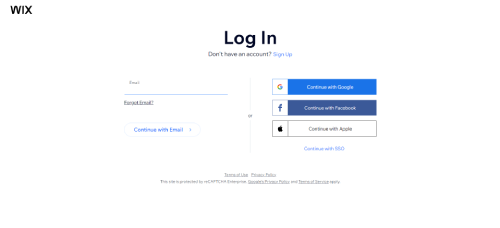
Start by accessing Wix and log in to your account. If you are new to Wix, select "Sign Up" and register with your email address or a connected social account. Wix offers a free plan that lets you publish a blog immediately, with paid plans starting at $17/month (see our full Wix cost breakdown) if you want a custom domain and no Wix branding.
Which Wix Template Should You Choose for a Blog?
Choose a template from the Blog category in the Wix template library. Blog-specific templates already include the Wix Blog app, a post feed layout, and category navigation, saving significant setup time compared to starting from a blank template.
Wix offers over 900 templates, with more than 60 specifically designed for blogs. To find them, go to your dashboard, click "Create New Site," then filter by "Blog" in the template category list. Look for templates that match your niche. Wix groups them by topic including food, travel, fashion, and lifestyle. You can also browse Wix blog examples to see what other bloggers have built before choosing a design. If you are building a full editorial publication rather than a personal blog, the best Wix magazine templates offer six layouts built specifically for multi-author and news-style sites.
Once you select a template, click "Edit" to open the Wix Editor. All template content is placeholder text. Replace it with your own during the setup process.
How Do You Add the Wix Blog App to Your Site?
Add the Wix Blog app by going to your Wix dashboard, selecting "Blog" from the left-hand menu, and clicking "Add Blog." If your template already includes a blog, the app is pre-installed and you can skip directly to creating posts.
The Wix Blog app is the core tool for managing all blog content. It handles post creation, categories, tags, author profiles, commenting, post scheduling, and member subscriptions. After adding the app, you will see the Blog Manager in your dashboard sidebar. This is where all blog content is created and organized. For a full walkthrough of adding a blog section to an existing site, see the guide on how to add a blog to Wix.
How Do You Write and Publish Your First Wix Blog Post?
Go to the Blog section of your Wix dashboard and click "Create New Post." The Wix post editor opens, where you write your content, add media, set categories and tags, configure SEO settings, and publish, all from a single screen. To include video content in your posts, see our guide on how to add video on Wix, which covers uploading, embedding from YouTube, and using the Wix Video app.
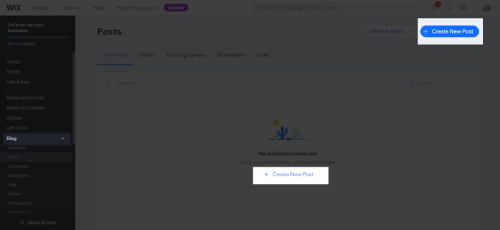
Creating a new post using Wix follows a consistent workflow each time:
- Click "Create New Post" from the Blog Manager
- Add your post title in the title field at the top
- Write your content in the body area below
- Add categories, tags, a cover image, and SEO details in the right-hand panel
- Click "Publish" or "Schedule" when ready
Wix autosaves your draft every few seconds, so your work is never lost if you close the editor unexpectedly.
How Do You Format a Wix Blog Post Correctly?
Use the Wix post editor's toolbar to format text with headings (H1–H6), bold, italic, and bullet lists. Insert images, videos, GIFs, and dividers using the "+" button on the left side of the editor. The editor is rich-text and requires no HTML knowledge.
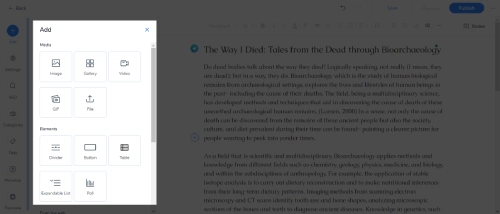
The Wix post editor supports the following content types inline:
- Images and galleries: upload from your device or pull from Wix's free media library (100+ million stock images)
- Videos: embed from YouTube, Vimeo, or upload directly
- Links: hyperlink any text to internal pages or external URLs
- Code blocks: for technical or developer-focused blogs
- Buttons: add call-to-action buttons inline within posts
For detailed guidance on working with the Wix text editor, see how to add and edit text on Wix.
How Do You Organize Posts with Wix Blog Categories and Tags?
Create categories in the Blog Manager under "Categories" before assigning them to posts. Tags are added directly within the post editor. Categories create a browsable structure for your blog; tags connect related posts across categories.
Categories work best as broad topic groups (e.g., "Recipes," "Travel Tips," "Product Reviews"). Each post can belong to one or more categories. Wix automatically generates a category page at a URL like /blog/category/your-category-name, which helps readers browse by topic and signals content structure to search engines.
Tags are more specific and flexible. Add 3–8 relevant tags per post (e.g., "vegan," "quick meals," "under 30 minutes"). Wix generates a tag page for each tag, giving each one its own indexable URL. Using both categories and tags increases the number of pages on your site that can rank for related search queries.
How Do You Configure SEO Settings for a Wix Blog Post?
Open the SEO panel in the post editor by clicking "SEO" in the right-hand sidebar. Set a custom meta title, meta description, and URL slug for each post. These settings directly control how the post appears in Google search results. If you plan to reach readers in multiple countries, you can also translate each post through the Wix Multilingual app, which creates separate indexed versions of your blog in each language.
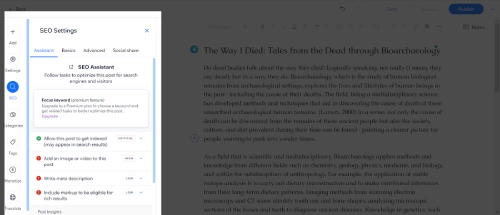
Follow these SEO best practices for each Wix blog post:
- Meta title: Keep it under 60 characters and include your primary keyword near the front
- Meta description: Write 140–160 characters that summarize the post and include a natural call to action
- URL slug: Use a short, hyphenated slug that matches your target keyword (Wix auto-generates one from the title, but you should manually simplify it)
- Focus keyword: Wix's built-in SEO Assistant prompts you to set a focus keyword and checks basic on-page signals
For a full guide to adding keyword metadata across your Wix site, see how to add meta tags on Wix and how to add keywords to your Wix website.
Can You Schedule Blog Posts on Wix?
Yes. In the post editor, click the dropdown arrow next to the "Publish" button and select "Schedule Post." Set a future date and time and click "Schedule." Wix publishes the post automatically at the specified time without any further action required.
Scheduling is useful for maintaining a consistent publishing cadence. Plan posts weekly or bi-weekly and schedule them in batches to reduce daily workload. Wix displays all scheduled posts in the Blog Manager with a "Scheduled" status label so you can track what is queued at a glance.
How Do You Publish a Wix Blog Post?
Click "Publish" in the top-right corner of the post editor to make a post live immediately. The post goes live on your blog feed and its individual URL becomes accessible to readers and search engine crawlers within seconds.
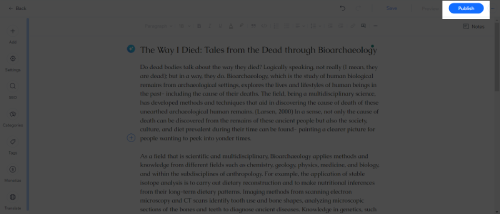
Before publishing, run through this final checklist:
- Title and body content are complete and proofread
- A cover image is set (this appears in the post feed and social share previews)
- At least one category is assigned
- Meta title, meta description, and URL slug are set in the SEO panel
- Any internal or external links have been added and tested
How Do You Customize Your Wix Blog Layout and Design?
Customize your blog's layout in the Wix Editor by clicking on the Blog feed widget and opening the "Settings" and "Design" panels. You can switch between grid, list, and masonry layouts, change the number of posts per row, and control typography and colors to match your brand.
The Wix Editor gives you full control over the blog's surrounding design, including the header, footer, navigation, sidebar, and page background, using the standard drag-and-drop interface. The blog post page itself uses a separate "Blog Post Page" template, accessible via the Pages menu, where you can customize the post layout including the position of the featured image, author bio, and related posts widget.
Key design options available through the Blog widget settings include:
- Feed layout: Grid (3 columns), side-by-side (2 columns), or one column list
- Post card elements: Toggle title, excerpt, author, date, reading time, and like count on or off
- Pagination: Choose between infinite scroll or numbered page navigation
- Sidebar: Add a search bar, recent posts, categories list, or tags cloud
How Do You Promote a Wix Blog?
Promote a Wix blog by sharing posts on social media immediately after publishing, enabling Wix's built-in subscription feature so readers get email notifications, and optimizing each post for search engines with targeted keywords and meta settings.
Sharing on Social Media
Social media is a powerful tool for driving early traffic to new posts. Share your posts on your personal and blog's social media accounts to reach a wider audience. Wix includes a built-in social share button on blog posts that generates pre-formatted share links for Facebook, X (Twitter), LinkedIn, and Pinterest with one click.
Engaging with Your Readers
Engaging with your readers builds a loyal following that returns to your blog regularly. Respond to comments on your blog posts. Wix's commenting system integrates with Wix Members, so commenters have profiles. Consider enabling the Wix blog subscription feature so readers receive an email notification each time you publish a new post. Wix handles the subscription management and delivery automatically.
Optimizing for Search Engines
Search engine optimization (SEO) is the most effective long-term promotion strategy for a blog. Beyond per-post meta settings, Wix provides a site-wide SEO checklist in the dashboard under "Marketing & SEO" then "Get Found on Google." This tool audits your site's technical SEO, including sitemap submission, structured data, and mobile readiness, and gives you actionable fixes.
Can You Make Money from a Wix Blog?
Yes. Monetize a Wix blog through 4 main methods: display advertising via third-party ad networks (Google AdSense), affiliate marketing links embedded in posts, selling digital products or courses via Wix Stores, or offering paid member subscriptions using the Wix Paid Plans app.
Affiliate marketing is the lowest-friction option for new bloggers. Add affiliate links to relevant posts and earn a commission each time a reader makes a purchase through your link. No inventory, no delivery, no customer service required. Display ads via Google AdSense require applying once your blog has consistent traffic (typically 1,000+ monthly visitors). Wix Paid Plans lets you lock specific posts or sections behind a paywall, suitable for premium newsletters or course-style content.
How to Get Your Wix Blog Posts Indexed Faster
Publishing a post on Wix does not guarantee Google will crawl it quickly. New blogs with low domain authority, no inbound links, and thin category pages can wait weeks before Google even notices a new post exists. Here is what actually moves the needle.
Submit the URL Directly in Google Search Console
Do not rely on sitemap submission alone. Open Google Search Console, paste your exact post URL into the URL Inspection tool at the top of the page, and click "Request Indexing." This sends a direct signal to Google to crawl that specific URL within hours rather than days. Wix automatically submits your sitemap at yourdomain.com/sitemap.xml, but the sitemap only tells Google the URL exists. The Inspection tool asks Google to prioritize it. Do this within 30 minutes of publishing every new post.
Add an Internal Link from an Already-Indexed Page
This is the single most effective thing you can do. Find an existing post on your blog that Google has already indexed (check via the URL Inspection tool or by searching site:yourdomain.com), and add a link from that post to your new one. Google follows internal links when it crawls. A new post with no incoming links from anywhere on your site is essentially invisible until Google stumbles across it through the sitemap. Even one relevant internal link from an indexed page can cut indexing time from weeks to days.
Enable Wix's "Get Found on Google" SEO Checklist
Many Wix users skip this. Go to your dashboard, click "Marketing & SEO," then "Get Found on Google." Wix walks you through connecting your site to Google Search Console, verifying site ownership, and submitting your sitemap if it has not been submitted already. These steps are prerequisites for Google to treat your blog as a trusted, regularly-crawled source. If you published your blog without completing this setup, your posts may not be in Google's index queue at all.
Check That Your Blog Category Page Is Indexed
Wix creates a category page for each blog category at /blog/category/your-category-name. If that category page is not indexed, the posts assigned to it have one fewer crawl pathway leading to them. Paste your category page URL into the Google Search Console URL Inspection tool and confirm it returns "URL is on Google." If it is not, request indexing for it separately.
Share on One Social Platform Within 24 Hours
Sharing a new post on Twitter/X, LinkedIn, or Facebook generates crawl signals. When Googlebot sees links pointing to a URL from external sites, it adds that URL to its crawl queue sooner. You do not need thousands of followers for this to work. Even a single share on a public social profile creates an external link that crawlers can follow. Post on whichever platform you already use and do it the same day you publish.
Common Wix Blog Mistakes to Avoid
Even well-structured Wix blogs miss these details. Fixing them before you accumulate dozens of posts prevents significant cleanup work later.
Leaving Auto-Generated URL Slugs
Wix auto-generates post slugs from the full title, sometimes appending a number when duplicates exist. "10 Quick Breakfast Recipes for Busy Mornings" becomes /blog/10-quick-breakfast-recipes-for-busy-mornings-1. Shorten it manually in the SEO panel before publishing. /blog/quick-breakfast-recipes is cleaner and easier to share. Once a post is live and ranked, changing the slug without a 301 redirect breaks existing links and discards ranking history.
Publishing Without a Category
Posts without a category do not appear on your blog's category pages, which cuts off a key set of internal links pointing to them. Google uses internal links to discover and evaluate content. An uncategorized post sits in isolation with no pages endorsing it. Create 3–5 categories before publishing your first post and assign every post to at least one.
Duplicate Meta Descriptions
Wix sometimes pre-fills every new post's meta description with the same template text. Identical meta descriptions signal to Google that content is interchangeable or low-value. Write a unique 140–160 character meta description for each post that accurately describes what is on that specific page.
Skipping the Mobile Preview
Wix maintains a separate mobile editor, and desktop changes do not always transfer cleanly. Text sizing, image alignment, and button spacing can break on small screens. Before publishing any post, switch to mobile preview in the Wix Editor toolbar and confirm the post reads correctly on a phone-sized screen. Google indexes the mobile version of pages first, so a broken mobile layout directly affects ranking.
Publishing Without a Cover Image
The cover image appears in your post feed grid, in social share previews on Facebook and X, and in Google's article rich results. A post without one shows a blank placeholder in the feed and no image when shared on social, both of which reduce click-through significantly. Use a 1200 x 628 px image for every post to cover blog feed display and Open Graph sharing.
No Internal Links Between Posts
Every new post should link to 2–3 relevant existing posts, and you should add links from 2–3 older posts pointing to the new one. Without this habit, new posts start with zero internal equity and may take months to get discovered and indexed. Internal links are how Google navigates your blog and assigns authority between pages.
How to Connect Your Wix Blog to an Email List
An email list is the most reliable channel for returning readers. Unlike social media, you own the subscriber list outright. An algorithm change cannot cut off your audience.
Wix Email Marketing (Built-In)
Wix includes a native email tool called Wix Email Marketing, part of the Wix Ascend suite. You can configure it to automatically send a campaign each time you publish a new post, pulling in the title, excerpt, and cover image from your blog automatically. The free Wix plan includes limited sends per month. For a blog with under 5,000 subscribers, this built-in option handles everything without third-party setup.
Connecting Mailchimp or Another Platform
If you use Mailchimp, GetResponse, or Constant Contact, connect it to your Wix blog through the Wix App Market. The Mailchimp app syncs Wix member sign-ups directly to your audience list and can trigger campaigns whenever you publish. Search the App Market for your email platform by name to find the official integration.
The Wix Blog Subscribe Button
Wix includes a built-in Subscribe widget for your blog. When a visitor clicks it, they create a Wix Member account and join your subscriber list. Wix automatically emails them each time you publish. No configuration is required beyond enabling the feature in Blog Settings. You can view all blog subscribers under Contacts in your Wix dashboard.
Your Blog's RSS Feed
Every Wix blog automatically generates an RSS feed at yourdomain.com/blog-feed.xml. Use this URL to connect your blog to external email automation tools via Zapier, to content aggregator directories, or to any RSS reader. The feed also makes your blog discoverable to newsletter writers and content curators who pull new posts automatically. No setup is required on your end beyond knowing the URL exists.
Conclusion: How To Create a Blog with Wix
Creating a blog with Wix involves adding the Wix Blog app, choosing a blog-ready template, writing posts with proper categories and SEO settings, and promoting your content consistently. The platform's drag-and-drop editor and built-in marketing tools handle everything a new blogger needs without any coding knowledge.
The details that separate a blog Google trusts from one it ignores are small but consistent: clean URL slugs set before publishing, every post assigned to a category, internal links added the day a post goes live, and a quick URL inspection request submitted in Google Search Console right after hitting publish. Do these four things on every post from the start and you will avoid most of the indexing and ranking problems that frustrate new Wix bloggers. Once your posts are live and indexed, see our guide on Wix keyword optimization to make sure each post is targeting the right search terms.
* read the rest of the post and open up an offer