

A search bar is one of the most practical features you can add to a Wix site. It gives visitors a direct path to the content they need, without relying on menus or manual browsing. While Wix includes search functionality in its editor, it does not appear on your site automatically. You need to add it yourself, and if you have never done it before, it helps to know exactly where to look.
This guide walks you through how to add a search bar in Wix from start to finish. You will also find tips on the different types of search available, how to customize the bar to match your design, how to read your search analytics, and answers to the most common questions Wix users have about site search.
- Adding a Wix search bar takes just a few minutes using the built-in Site Search element in the Wix Editor.
- Wix supports blog search, store search, and full site search, each suited to different site types.
- You can customize the search bar's size, style, and placement to match your site's design before publishing.
- If your search bar is not returning results, the most common cause is an indexing delay or a content type that has not been enabled in Search settings.
Step-by-Step Guide: How To Add a Search Bar in Wix
Adding a search bar to your Wix website is straightforward using the built-in Wix Editor. The steps below work for any Wix site type: blog, online store, or portfolio. Follow along to get your Wix site search up and running.
Step 1: Log Into Your Wix Account
Go to Wix.com and sign in to your account. If you are new to Wix, create a free account using your email address or a connected social media account. Existing users can skip this step and head straight to the dashboard.
Step 2: Open the Wix Editor
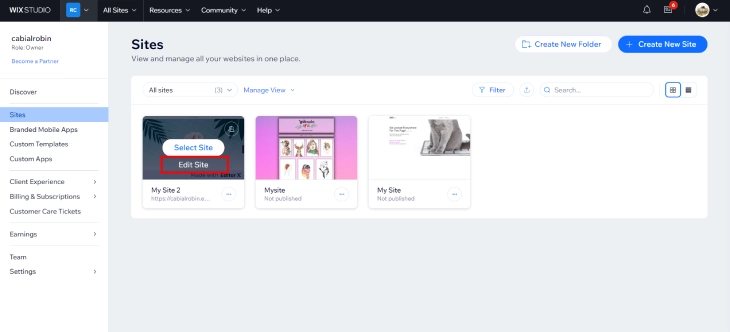
From your dashboard, click Go to All Sites, then select the site you want to edit. Click Edit Site to launch the Wix Editor. This is your main workspace for adding and adjusting elements across your pages. If you are new to the editor, our guide on how to use Wix covers the basics before you get started.
Step 3: Add the Search Bar Element
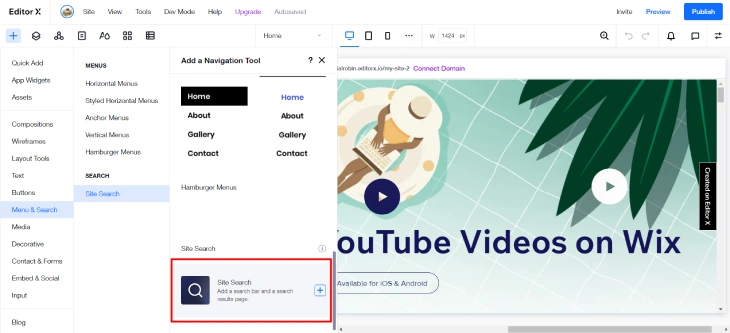
In the Wix Editor, click the + (Add Elements) button on the left-hand panel. From the dropdown, select Menu & Search, then choose Site Search. Clicking it adds a search bar widget directly to your page, along with a dedicated search results page that Wix creates automatically.
Step 4: Customize the Search Bar
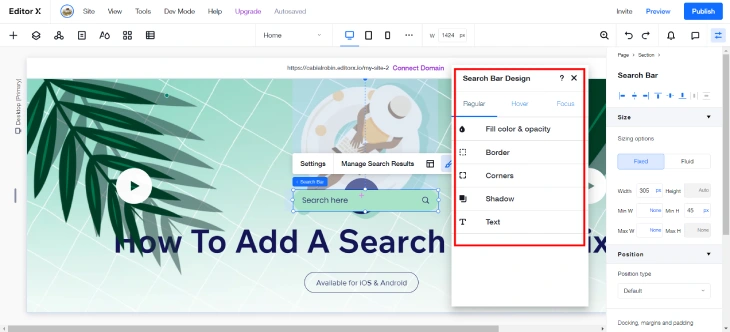
Click on the search bar element to open its settings. From here you can adjust the width, height, font, border style, and background color to match your site's branding. You can also drag the bar to reposition it on the page. For best results, place the search bar in the header so it appears on every page of your site. See the customization tips section below for more options.
Step 5: Publish Your Site
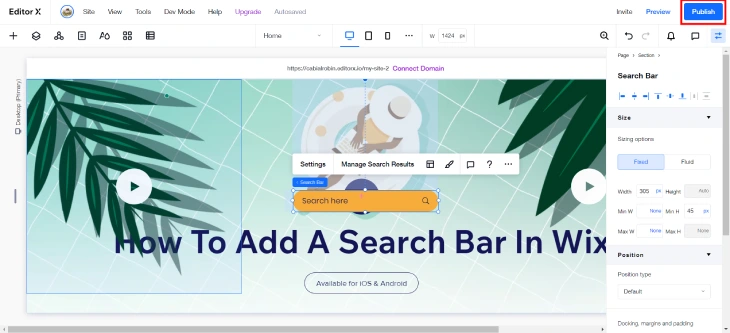
Once you are happy with the placement and design, click Publish in the top-right corner of the editor. After publishing, open your live site and test the search bar by entering a few keywords. Check that results load correctly and that the bar displays properly on both desktop and mobile.
Types of Search in Wix
Wix offers a few different search configurations depending on what kind of site you are running. Understanding which type fits your needs helps you set up search in a way that actually serves your visitors.
Full Site Search
The default Site Search element in Wix searches across all indexed content on your website: pages, blog posts, products, events, and more. This is the most versatile option and the one most users should start with. When a visitor types a query, Wix returns results from every section of the site it can index. This is ideal for multi-purpose sites that combine a blog, portfolio, and shop in one.
Blog Search
If your Wix site is primarily a blog, you may want search results limited to blog posts only. Wix Blog includes its own search widget that you can add specifically to your blog pages. This keeps results focused and avoids returning unrelated product or portfolio pages. To add blog search, go to + > Blog in the Wix Editor and look for the Blog Search widget. For a deeper look at building a blog on Wix, see our guide on how to design a website with Wix.
Wix Stores Search
For Wix eCommerce sites, the Wix Stores app includes product search functionality. When enabled, visitors can search your product catalog by name, description, or category. To enable store search, open the Wix Editor, go to + > Store, and add the Search Bar widget from the Wix Stores elements. Store search is separate from site search and only returns product results, which is usually exactly what shoppers want.
Wix CMS (Collections) Search
If your site uses Wix CMS to display dynamic content from a database collection, such as a portfolio of projects, a listings directory, or a recipe archive, the standard Site Search element may not index that content by default. For CMS-driven sites, you have two options: use the Wix Search element and enable the relevant collection as a searchable source in the Search & Category Manager (found in the Editor under Search), or build a custom filtered search using Wix Velo and dataset filters. The second approach offers more control but requires some coding knowledge. For most content-driven sites, enabling the collection in the Search & Category Manager is the simpler and faster solution.
Search Bar Customization Tips
Getting the search bar to look right takes a few minutes of tweaking. Here are the most useful customization options available in the Wix Editor:
- Placement: Adding the search bar to your site header means it appears on every page automatically. Go to Pages & Menus > Header and drop the element there.
- Icon vs. expanded bar: Wix lets you display search as a small magnifying glass icon that expands on click, or as a full-width input field. The icon style is less intrusive for minimalist designs; the expanded bar is better for content-heavy sites.
- Placeholder text: Edit the default "Search..." placeholder to something more specific, like "Search recipes" or "Find a product." This helps users understand what they can search for.
- Color and borders: Match the search bar's background and border color to your site palette. Click the element, open Design, and adjust fill and border settings.
- Mobile layout: Always switch to mobile preview after placing the search bar to confirm it fits the smaller screen. Wix's mobile editor lets you reposition the element independently of the desktop layout.
- Search results page: When you add Site Search, Wix creates a results page automatically. You can edit this page's layout by going to Pages & Menus and selecting the Search Results page. Customize fonts, colors, and the number of results shown per page.
If you want to go further with your site's navigation, our guide on how to create a dropdown menu on Wix pairs well with search bar setup. Together they give visitors multiple ways to find content.
How to Read Your Wix Search Analytics
Once your search bar is live and visitors start using it, Wix logs every query automatically. This data is one of the most underused resources available to Wix site owners. Here is how to access it and what to do with it.
Accessing Search Query Data
From your Wix dashboard, go to Analytics & Reports and look for Site Search in the left menu. This report shows a list of the most common search terms your visitors have typed, along with the number of times each query appeared. Wix typically surfaces the top 100 queries from the selected date range.
What the Data Tells You
Your search analytics reveal several things that are hard to know otherwise:
- Content gaps: If visitors are searching for something you do not have a page about, that is a signal to create one. For example, if 50 people searched "return policy" on your store but you do not have that page, they are leaving without the answer they need.
- Navigation failures: High search volume for content that already exists on your site usually means visitors cannot find it through your menus. Consider making that page more prominent in your navigation.
- Product interest: On eCommerce sites, frequent product searches show you what customers want most. This data can inform inventory decisions, homepage promotions, and product naming.
- Misspellings and synonyms: Seeing how visitors phrase their searches helps you write better content using the same vocabulary your audience uses, rather than industry jargon.
Acting on the Data
Review your search analytics at least once a month. Make a list of the top 10 searches that either return poor results or return nothing at all. Prioritize creating or improving pages for those queries. Even small improvements, such as adding a FAQ entry that directly answers a common search, can meaningfully reduce the number of visitors who leave your site without finding what they came for.
Why Adding a Search Bar to Your Wix Site Matters
A search bar does more than help visitors find things faster. It directly affects how long people stay on your site, how many pages they visit, and whether they come back. Here is why it is worth prioritizing:
Improved User Experience
Navigation menus work for sites with a handful of pages, but they break down as your content grows. A Wix search bar lets visitors skip straight to what they need using their own words. This reduces friction, lowers the chance they leave out of frustration, and keeps the experience feeling organized, even on sites with hundreds of posts or products.
Better SEO Signals
When users find what they are looking for quickly, they spend more time on your site and visit more pages. Both of these behaviors, lower bounce rate and higher pages-per-session, are positive signals to search engines. Wix also logs internal search queries in its analytics dashboard, which means you can see exactly what visitors are searching for and use that data to fill content gaps or improve existing pages.
Increased Engagement and Conversions
Visitors who use search bars are often higher-intent users: they know what they want and are actively looking for it. On a store, a working product search bar can directly increase conversions. On a blog, it keeps readers engaged longer by surfacing related content they might not have found through browsing alone.
Get Your Wix Search Bar Live
Adding a search bar to your Wix site takes less than five minutes, but the impact on usability can be significant. Using the Site Search element in the Wix Editor, you can give every visitor a direct path to the content they need, whether that is a blog post, a product, or a portfolio piece.
Start with the full site search for most use cases. If you run a dedicated blog or store, consider using the specialized search widgets for more focused results. For CMS-driven content, check that your collections are enabled as searchable sources in the Search & Category Manager. Spend a few extra minutes on customization: placement in the header, a clear placeholder, and a consistent color scheme. Then use your search analytics each month to find content gaps and improve your site based on what visitors are actually looking for.
Once your search bar is live, test it on both desktop and mobile to make sure results load correctly and the design holds up across screen sizes.
How to Add a Search Bar in Wix Studio
Wix Studio (formerly Editor X) uses a different interface than the classic Wix editor, and the process for adding a search bar reflects that. If you have been following guides written for the classic editor and cannot find the right panel, that is likely why.
In Wix Studio, open the editor and click the Add Elements button in the left panel. Search functionality lives under the Search category, but if you do not see a "Site Search" element listed, you will need to install it separately. Go to App Market within the editor, search for "Wix Search," and add it from there. Once installed, the element becomes available in your panel and you can drag it onto any section of your site.
One area where Studio genuinely improves on the classic editor is CMS integration. If your site uses CMS collections (products, blog posts, custom content types), Studio's search element connects to them more directly. During setup, you can select which collections should appear in search results without needing to configure each one through a separate app. This matters if you are running a content-heavy site with multiple custom content types.
Studio also gives you breakpoint-level control over how the search bar looks. Click on the search element, then use the breakpoint bar at the top of the editor to switch between desktop, tablet, and mobile views. You can adjust the width, font size, placeholder text, and button styling independently at each breakpoint. This means your desktop search bar can be wide and prominent while the mobile version collapses to an icon, all without custom CSS.
For developers building on Studio, the Wix Search API via Velo opens up fully custom search implementations. You can write JavaScript in the Velo panel to query specific CMS collections, filter results by field values, sort by custom criteria, and display results in a layout you design yourself, rather than using the default search results page. This is useful when you need search to behave differently from what the out-of-the-box element supports.
One common issue on Studio sites: after adding the search element, some users find results are incomplete or missing certain content types. Check your Search Settings (found in the App Market under the installed Wix Search app) and confirm that each content type you want included is toggled on. Studio sites with large CMS datasets can sometimes take 24 to 48 hours after enabling a new content type before it shows up in search results.
Wix Search Bar SEO: Does On-Site Search Help Your Rankings?
Adding a search bar to your Wix site has no direct effect on how Google ranks your pages. Google does not look at whether visitors use your internal search. That said, on-site search does affect your rankings indirectly, through the behavioral signals it influences.
When visitors can find what they are looking for quickly, they stay longer, visit more pages, and do not immediately bounce back to Google's results. Those signals (time on site, pages per session, low bounce rate) are correlated with better rankings, even if they are not direct ranking factors in Google's published documentation. A well-placed, functional search bar can contribute to those numbers, especially on content-heavy or e-commerce Wix sites where visitors often want to explore beyond the page they landed on.
However, there is one SEO issue specific to Wix search that you should address. When you add the Wix Search element, Wix automatically creates a Search Results page on your site. This page is dynamic, meaning its content changes based on whatever query a visitor types. Google treats these pages as low-quality because the content is not stable or crawlable in a meaningful way. You should tell Google not to index it.
To noindex your Wix search results page, go to Pages & Menu in the editor, find the Search Results page, click the three-dot menu, and select Page Settings. Under the SEO Basics tab, toggle off "Let search engines index this page." Save and republish. This prevents Google from wasting crawl budget on a page that offers no value to searchers.
Another issue to be aware of: if your search bar generates URL parameters (for example, yoursite.com/search?q=keyword), Google may treat different query variations as separate pages with thin content. Wix handles canonical tags automatically for most page types, but it is worth checking your Search Results page in Google Search Console to confirm it is not getting indexed or generating duplicate content warnings.
Finally, your Wix search query data is one of the most underused content research tools available to you. In Wix Analytics, under the Site Search report, you can see exactly what words visitors type into your search bar. Terms that appear frequently but return few results tell you what content your site is missing. That is a direct feed into your content calendar, based on what your actual audience is already looking for.
Common Wix Search Bar Problems and How to Fix Them
The search bar added successfully but it is not behaving the way you expected. Here are the seven problems Wix users report most often, with specific fixes for each:
Problem 1: Search Returns No Results at All
This is the most reported issue, and it almost always has one of three causes. First, newly added or recently published content can take up to 24 hours to be indexed by Wix's internal search. If you just published a page and it is not showing up, wait a day and test again. Second, if you have a new site, Wix search requires you to publish the site at least once before any content is indexed. Previewing the editor does not count. Third, if you have a CMS collection, make sure that collection is enabled as a searchable source in the Search & Category Manager.
Problem 2: Search Only Returns Some Pages, Not Others
By default, Wix indexes static pages (about, contact, services) and blog posts. It does not automatically index CMS collection items, events, or some app-specific content. To include those, go to your dashboard, open the Wix Search app settings (or the Search & Category Manager in the editor), and toggle on the content types you want included. Each type you enable appears as a separate tab in search results, which also helps users filter by content type.
Problem 3: The Search Bar Appears on Desktop but Not Mobile
In Wix's classic editor, elements can be hidden on mobile independently of their desktop visibility. If you added the search bar on desktop, switch to the mobile editor and check that the element is not set to hidden. Click the search bar in mobile view, look for the "Hide" toggle in the element settings, and turn it off. Then republish.
Problem 4: Search Results Page Looks Nothing Like My Site
Wix creates a search results page automatically when you add Site Search, and it uses the default layout, not your site's custom styles. To fix this, go to Pages & Menus, find the Search Results page, and edit it like any other page. Update the fonts, colors, header, and footer to match the rest of your site. Any design changes you make there apply only to the search results layout.
Problem 5: Search Shows Results From Pages I Do Not Want Included
If certain pages (like a thank-you page, a private landing page, or an outdated post) are showing up in search results, you have two options. The cleaner fix is to go to the Search & Category Manager and deselect the content types you want excluded. For individual pages, you can also hide them from site search directly: in the Wix Editor, go to Pages & Menus, click the three-dot menu next to the page, and look for Hide from Search or Page Settings > SEO to tell Wix not to index it internally. See the next section for more detail on controlling which content appears in search.
Problem 6: Clicking a Search Result Goes to a 404 Page
This happens when a page's URL (slug) was changed after the search index was built. Wix's internal search index can take 24 hours to catch up after a URL change. If you recently renamed a page or changed its slug, wait a day and test again. If the issue persists, try republishing the site to trigger a full re-index.
Problem 7: Search Bar Is Not Showing in the Header After Being Added There
If you added the search bar to the header but it is not appearing on all pages, the most likely cause is that it was added to a section that is not set as the global header. In the Wix Editor, scroll up to the very top of the page and confirm you are editing the area labeled Header, not a regular section at the top. Elements placed inside the header automatically appear on every page. If you placed it in a regular section, it will only appear on that page. Delete the element and re-add it to the actual header area.
How to Limit Wix Search Results to Specific Pages or Content Types
By default, Wix site search returns results from every type of content it can index. For many sites, that is exactly what you want. But for others, especially those that mix a public-facing blog with a members-only section, a product catalog, and a resource library, showing everything in one search box can overwhelm visitors or surface content that is not meant for everyone.
Here are your options for narrowing down what Wix search returns:
Using the Search Category Manager
The most direct way to control what appears in search is the Search & Category Manager. Open your Wix Editor, go to Search in the left panel (or find it under the Wix Search app in your dashboard), and you will see a list of all content types Wix can index: Pages, Blog Posts, Wix Stores Products, Bookings Services, Events, and any CMS collections you have created. Toggle off any category you do not want included in results. Changes take effect after you republish your site and allow time for re-indexing.
Hiding Individual Pages From Search
For one-off exclusions (a specific page you want to keep live but off the search results), the page-level settings offer a simpler option. In the Wix Editor, go to Pages & Menus, click the three-dot menu next to the page, and select Page Settings. Look for the option to hide the page from internal search. This removes that specific page from Wix's search index while leaving everything else visible.
Members-Only and Paid Content
If your site has a Members Area with gated content, Wix automatically excludes private member pages from general search results. Non-logged-in visitors will not see members-only content in search, even if the search element is placed on a public page. However, this is based on page-level permissions, not content-level permissions. If you publish a blog post without restricting it and then later add it to a members-only category, it may still appear in search results until you explicitly set the post to members-only access.
Building a Filtered Search With Velo
For advanced use cases, such as a search bar that only searches a specific CMS collection by a specific field, Wix Velo lets you build a fully custom search experience. Using the wix-data module, you can write a query that filters results by any collection field, then display those results in a repeater or custom layout instead of the standard search results page. This approach requires JavaScript knowledge but gives you complete control over the search logic and output format.
* read the rest of the post and open up an offer